When Words Are Not Enough
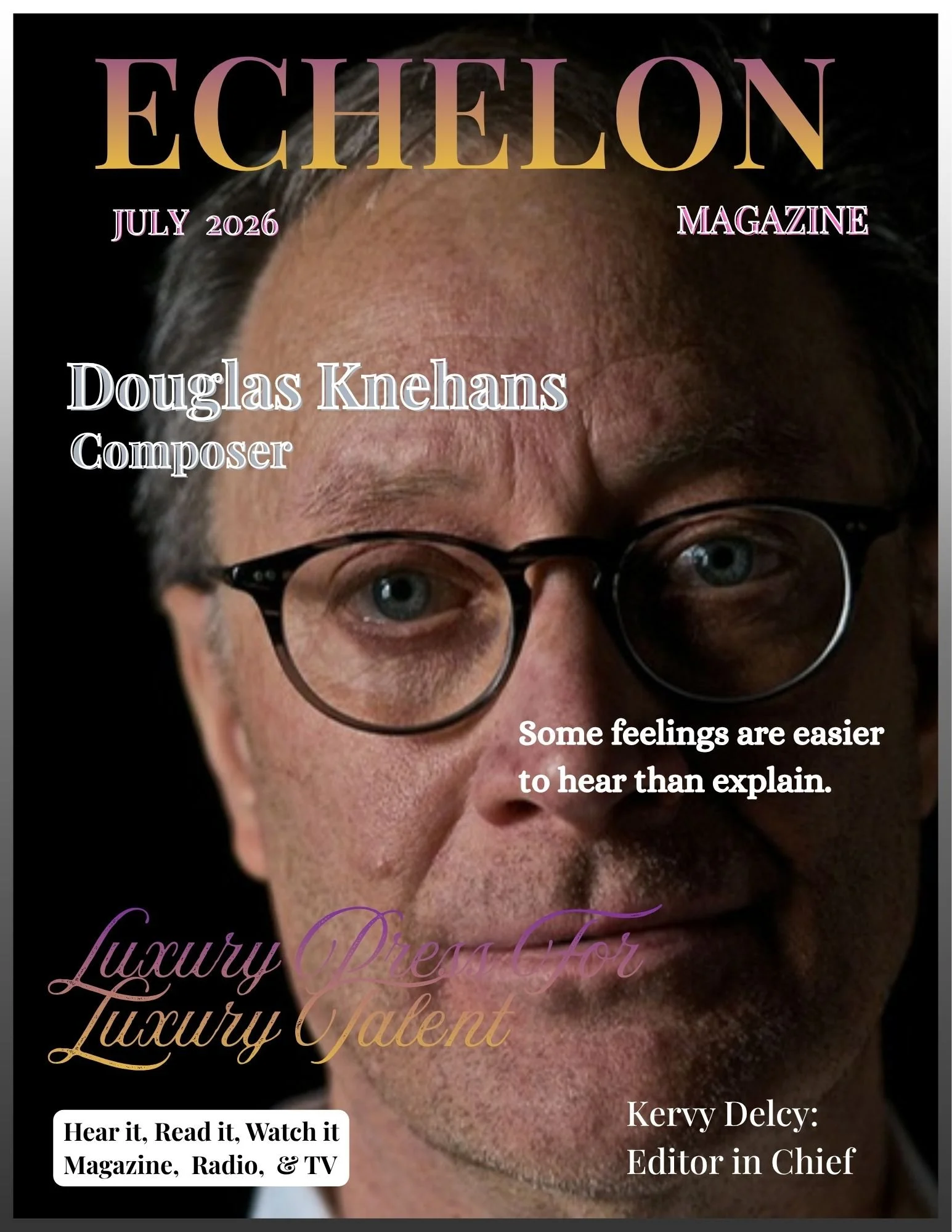
Douglas Knehans on Music, Memory, and the Emotional Life of Music
Sooner or later, everyone runs into something words cannot quite hold.
A profound loss. An unexpected joy. The quiet realization that life has changed in ways from which there is no returning. We search for words, rearrange sentences, begin again, and still find ourselves sensing that something essential has escaped us. Language, remarkable as it is, eventually reaches its limits.
Douglas Knehans became a composer because he encountered those limits early.
He told me that one reason he gave his life to composition was the growing sense that words could not always reach what mattered most. Certain experiences, emotions, and questions seemed to sit just beyond ordinary conversation. Music, he discovered, could move toward them with an immediacy speech rarely achieves. “There are a lot of things we experience as people,” he reflected, “that we just don’t talk about... But those are the real things that make us human.” Those difficult-to-name experiences have become the territory he has spent a lifetime exploring in sound.
That conviction has shaped an unusually wide-ranging career. Born in St. Louis and raised in Australia from the age of fourteen, Knehans has become a prominent voice in contemporary composition, with music performed by orchestras, chamber ensembles, opera companies, and soloists around the world. His work is known for its dramatic intensity and expressive imagination, and his leadership as founder of ABLAZE Records and codirector of the Thessaloniki Art and Music Summit has helped open doors for other composers. Yet in conversation, the résumé quickly recedes. What keeps returning is something simpler and more urgent.
"The emotional power of music."
He spoke those words without ceremony, yet they illuminate nearly everything else he shared. Styles evolve. Techniques change. Musical fashions come and go. What is left, he believes, is music's extraordinary ability to move another human being.
Listening to Knehans, I was struck by how quietly radical that position can feel. Contemporary composition is often framed through technique, systems, aesthetics, and innovation. Knehans values craft as deeply as any composer, but he refuses to treat it as the destination. Technique matters because it allows music to communicate. Without that purpose, even the most sophisticated score risks becoming an exercise rather than an experience.
Still Looking
Artists are often asked when they found their voice, as though artistic identity arrives at a single decisive moment before remaining permanently intact.
Knehans has never believed that.
While studying composition at Yale, he asked his teacher, Jacob Druckman, a question that had quietly occupied his own imagination.
"When did you find your compositional voice?"
Druckman's answer surprised him.
"I think I'm still looking for it."
Decades later, Knehans still returns to that exchange. It has become less an anecdote than a way of understanding artistic life itself. Rather than seeing artistic voice as something one finally possesses, he thinks of it as something continually pursued. Each composition opens another possibility. Each score leaves another question alive. Even now, after symphonies, operas, concertos, recordings, and decades of teaching, he smiles when he says he feels close, but is still “chasing that last rainbow.”
Writing for Real People
Ask Douglas Knehans about composition long enough, and the conversation will eventually leave the composer’s desk for the rehearsal room, where music depends on the people asked to bring it to life.
It arrives in the rehearsal room.
Again and again, he returned to performers, not simply as musicians who realize a score, but as collaborators whose artistry deserves the composer’s full attention. His advice to young composers is strikingly practical: talk to conductors, talk to instrumentalists, learn what an instrument can truly do. Make the music performable. Not easier, exactly, but playable in a way that lets performers devote themselves to expression rather than merely surviving the technical demands on the page.
There is an important distinction here. Knehans is not arguing against ambition or complexity. His own music is rich in color, structure, and technical imagination. What he questions is the habit, still present in some corners of contemporarymusic, of treating difficulty as proof of seriousness. Complexity by itself communicates very little. A performer should leave rehearsal challenged, certainly, but also convinced that every demand serves a musical purpose.
Listening to him, I was reminded that composition is, in many ways, an act of generosity. Long before audiences hear a single note, performers spend weeks or months inhabiting a score, solving its problems, discovering its character, and gradually making it their own. Knehans understands that relationship with unusual clarity. He writes not only for instruments, but for the musicians holding them. Perhaps that is why his music possesses such remarkable dramatic intensity. It asks much of performers yet never asks for difficulty without reason.
The same philosophy runs through his work as an educator. He urges students to look outward as well as inward, to consider not only what they wish to say, but how listeners might receive it. Music, he believes, is not diminished by communication; it is fulfilled by it. Young composers can become preoccupied with being different before asking whether their ideas can truly be understood. Originality matters, of course, but originality without communication can become a private language spoken to an empty room.
Giving Music a Home
That commitment to communication extends well beyond Knehans' own compositions.
For more than three decades, he has devoted substantial energy to creating opportunities for other composers. As founder and Artistic Director of ABLAZE Records, he has helped produce more than ninety commercial recordings representing over one hundred and fifty composers, many of whom might otherwise have struggled to find space in a crowdedrecording landscape. What began in Australia as a way to support colleagues gradually became an international label dedicated to giving contemporary composers a professional platform from which their music could reach performers, presenters, and audiences around the world.
When I asked why independent labels still matter, his answer was refreshingly direct. Without them, many composers simply would not be heard. Established names will usually find their way to recordings. Emerging voices rarely have that certainty. Independent labels help keep contemporary music a living conversation, rather than a catalogue reserved for those who have already achieved broad recognition.
That same conviction is evident in the Thessaloniki Art and Music Summit, which he co-directs with Diogo Carvalho in collaboration with the Thessaloniki State Symphony Orchestra. Rather than championing a single aesthetic, the festival brings together composers from different countries, traditions, and musical perspectives, placing their works side by side in rehearsal and performance. Knehans spoke warmly about hearing those voices come alive through the orchestra, and about the value of composers learning from one another in real time. Diversity, for him, is not a slogan. It is something heard.
Across these roles, composer, teacher, producer, artistic director, a remarkably consistent philosophy emerges. Whether writing a concerto, producing a recording, or helping organize an international festival, Knehans keeps returning to the same essential question.
How can this music find the people it was meant to reach?
Music as Remembrance
As our conversation drew to a close, I asked Knehans what he hoped his work would leave behind.
His answer surprised me.
Although he has led conservatories, founded institutions, produced recordings, and devoted decades to teaching, he did not hesitate.
His legacy, he said, is his music.
Among his works, one stands apart with particular significance: his Shoah Requiem, a monumental seventeen-movement meditation on the Holocaust. He spoke of it not as a professional milestone, but as an act of remembrance. Some chapters of history, he believes, must be kept present because they reveal the terrible consequences of forgetting our shared humanity. Music cannot undo those tragedies, but it can preserve memory with a depth that facts alone often cannot.
Perhaps that is why the phrase that stayed with me throughout our conversation was not about orchestration, awards, or compositional technique.
It was about being human.
"There are a lot of things we experience as people that we just don't talk about."
Those words seem to illuminate everything Douglas Knehans has spent his life creating. His symphonies, operas, concertos, recordings, and festivals vary widely in subject and scale, yet they share a single purpose: to give voice to experiences ordinary conversation cannot fully hold. The craft is there, but it never feels like the point. What matters is what the music asks of us: to feel, to remember, and perhaps to recognize something of ourselves in the lives of others.
That is no small ambition.
For listeners encountering Knehans for the first time, that may be the most compelling place to begin. Not with reputation or category, but with the question at the center of his work: what can music say when words fall short? His answer has taken the form of symphonies, operas, concertos, recordings, and opportunities created for other composers. Together, they point toward an artist still searching, still listening, and still trusting that music can reach places language cannot.