Irena Portenko’s Courage to Listen
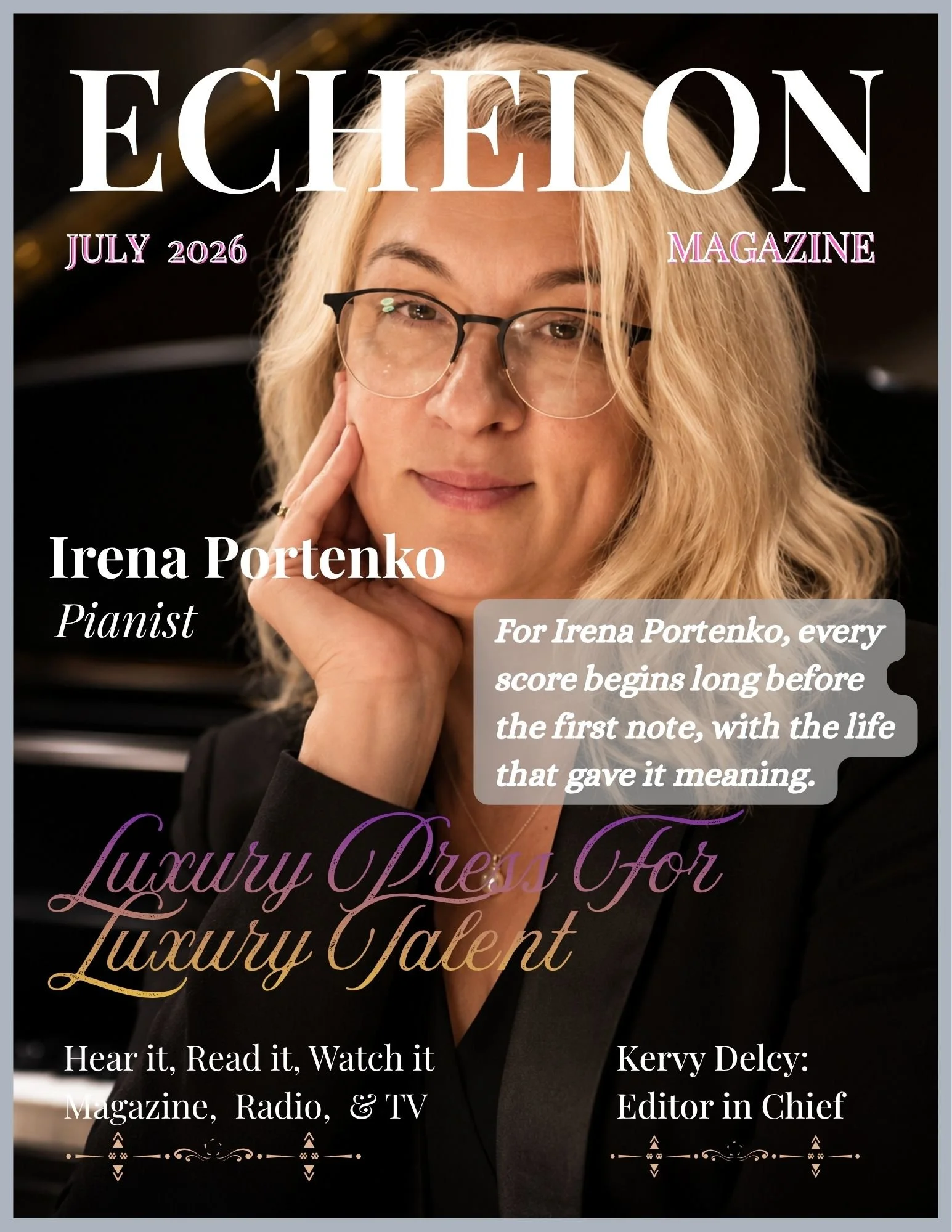
The Ukrainian-born pianist, teacher, and festival founder has built a career around the art of hearing what lies beneath the notes.
“Irena Portenko listens past the notes, toward the life that gives music its voice.” – Echelon
There is a tendency to romanticize the beginning of an artist’s journey. We imagine a child falling in love with an instrument, discovering an irresistible passion, and pursuing it with unwavering certainty. It is a beautiful narrative, but reality is often more complicated. Some musicians choose their instrument. Others discover it gradually. And then there are those, like pianist Irena Portenko, for whom music arrived long before choice entered the conversation.
When I asked whether she had ever chosen the piano for herself, her answer immediately caught me off guard.
"Never."
She laughed before explaining that the decision had never truly belonged to her. Her mother noticed that she could sing in tune as a toddler and decided music would become part of her life. At two-and-a-half years old, there was little room for negotiation. “Nobody asked me,” she recalled with a smile. “That was it. That was the only thing I knew when I was little.”
There is something wonderfully disarming about that answer. In an era that celebrates carefully planned careers and self-made destinies, Portenko’s story begins almost accidentally. Yet what followed was anything but ordinary. Music quickly ceased to be an extracurricular activity and became the environment in which she grew up. While most children slowly discovered their interests, she was already practicing, performing, and learning to listen with unusual seriousness.
By eight, she was appearing as a soloist with a professional orchestra, an experience she remembers not through applause, but through a single revelation: the orchestra began to follow her. She still recalls watching seasoned professionals respond to the smallest changes in her phrasing and tempo. At first, she feared they would never take a child seriously. Instead, she realized that musical leadership had little to do with age. “They were following me,” she remembered. “They did whatever I did.” Even as a young girl, she understood that music was never merely about correct notes. It was about persuading other musicians to breathe, phrase, and imagine together.
That experience continues to shape the way she teaches today. Technical mastery remains essential, but confidence, she believes, must be cultivated just as deliberately. She wants young musicians to develop skill before comparison, self-consciousness, and the pressures of growing up begin to narrow their sense of possibility.
Portenko’s life has since moved across countries and roles: Ukrainian prodigy, American-Ukrainian concert pianist, chamber collaborator, recording artist, teacher in Westchester, and founder of Music in the Alps. Her résumé includes a 2009 debut at Carnegie Hall’s Weill Recital Hall, appearances with the National Symphony Orchestra of Ukraine, and the album Versus, recorded with conductor Volodymyr Sirenko and the Ukrainian National Symphony Orchestra. In recent years, after Russia’s full-scale invasion of Ukraine, she has also turned concerts into benefit work. But the most revealing thing about her is not the list of stages, titles, or causes. It is the way she talks about listening.
The Cost of Early Excellence
She grew up within the rigorous musical education system of the former Soviet Union, where extraordinary standards were expected from children barely old enough to understand them. Admission required competitive examinations, and once accepted, students spent days in scales, dictation, chalk dust, cold practice rooms, and the metallic repetition of solfège syllables. Harmony, sight-singing, transposition, theory, and performance stood beside mathematics, literature, and science; music was not enrichment, but a language requiring fluency.
The education was remarkable, but it was rarely gentle. Wrong notes seemed to linger in the air after class, as sharp as a teacher’s pencil against a score. Comparisons were routine, competitions constant, and perfection hovered just beyond reach. Portenko speaks of those years with both gratitude and honesty. “The result was playing,” she reflected, “but everything else was really, really difficult to handle.”
The pressure did not erase her love for music, but it complicated it. What she inherited from that system was formidable: discipline, ear training, stamina, and a seriousness about art that cannot be improvised later. What she also carried forward was a knowledge of how easily excellence can become fear. The tension between those two inheritances, rigor and tenderness, runs through much of her work now.
The Teachers Who Stayed With Her
For Portenko, teachers were more than technicians of the keyboard. They arrived at different moments with different gifts: discipline, imagination, philosophy, and a deeper way of listening. One story remained impossible to forget.
As a teenager, she studied with a professor whose musicianship opened a new world. Their time together lasted only three months, yet it altered the course of her artistic life. After a jury examination, while she waited outside for the results, the corridor held the familiar after-sounds of a conservatory: footsteps on hard floors, fragments of scales behind closed doors, the dry whisper of pages. Then her professor collapsed from a heart attack and died before her eyes. What stayed with her was not only the tragedy, but what he had awakened in her: a way of hearing rooted in imagination, philosophy, and depth. “I understood that I could not exist without this world,” she reflected.
Another teacher eventually guided her through both grief and growth. Looking back, Portenko speaks of her mentors as links in a chain: each inherited something and added something of their own. That inheritance now shapes the educator who teaches in Westchester and directs young musicians through private study, master classes, and festival work. She often speaks of “passing it on”, not simply knowledge, but an approach that joins technical excellence with intellectual curiosity.
That phrase carries weight because Portenko does not describe teaching as a secondary identity. Performance and teaching appear, in her mind, as part of the same continuum. One asks how to bring a score to life in public; the other asks how to help another person discover the courage to do the same. In both cases, the work begins with attention.
Before the First Note
Her approach to a new piece begins before her hands touch the keys.
Before she studies the score, she studies the composer: where they lived, what their country was enduring, whom they loved, what they feared, and to whom the work was dedicated. Before she plays, she is already listening for weather, rooms, letters, grief, celebrations, streets, and silences. “Everything affects the writing,” she explained. “If I don’t know these details, I cannot play the piece.”
This habit gives her interpretations a particular shape. She is not interested in biography as decoration or historical detail as trivia. She wants context to change the sound itself: the weight of a bass line, the tenderness of a cadence, the urgency behind a sudden turn of harmony. The research matters only if it becomes audible.
The same openness explains her affection for living composers. She described them as “mediums to their music,” and in rehearsal the score becomes a conversation: the performer brings imagination, the composer brings intention, and the music reveals itself somewhere between the two.
I saw that quality from the other side of the score when Portenko premiered one of my works at Carnegie Hall. In rehearsal, she did not treat the music as finished because it had been printed. The room held its own concentration: the soft thud of the piano bench, the gleam of the music stand light, the silence before she tried a phrase again. She asked about breath, color, pacing, and intention; then she made suggestions that felt less like interventions than discoveries. Onstage, the piece sounded more fully itself than it had on the page.
That experience clarified something essential about her musicianship. Portenko does not impose personality on a piece to make it seem dramatic. She listens until the drama already inside the music becomes unavoidable. The result is a kind of authority that
does not announce itself loudly; it gathers force through patience.
What Perfection Misses
Toward the end of our conversation, I asked what advice she would offer her younger self. Her answer was unexpectedly tender: “It’s going to be okay.”
With time, her understanding of failure changed. A wrong note, she now tells students, is rarely the greatest mistake a performer can make. Wrong notes can be corrected, even transformed. The greater mistake is performing without honesty. “If you’re not truthful to what you’re doing,” she said, “if you’re not playing the way that touches your heart, that is the big mistake.”
It is the kind of answer that could sound simple if it had not been earned. Coming from Portenko, it feels like the conclusion of a long argument with perfection: not a rejection of standards, but a refusal to let standards become the only measure of a musical life. The goal is not to make mistakes disappear. The goal is to make meaning survive them.
By the end of our conversation, Portenko’s career seemed held together by a single artistic habit. Whether performing Beethoven for a benefit audience, recording Prokofiev and Tchaikovsky with a Ukrainian orchestra, teaching in Westchester, or guiding young musicians through Music in the Alps, she begins by asking what a piece is carrying before she decides how it should sound.
That may be what makes her artistry feel durable. In a culture drawn to speed, polish, and spectacle, Portenko argues, quietly, insistently, for attention.
For her, the deepest listening is not directed only toward the piano. It is directed toward the life that gives the music its voice.