The Evolving Musical Voice of Kevin Day
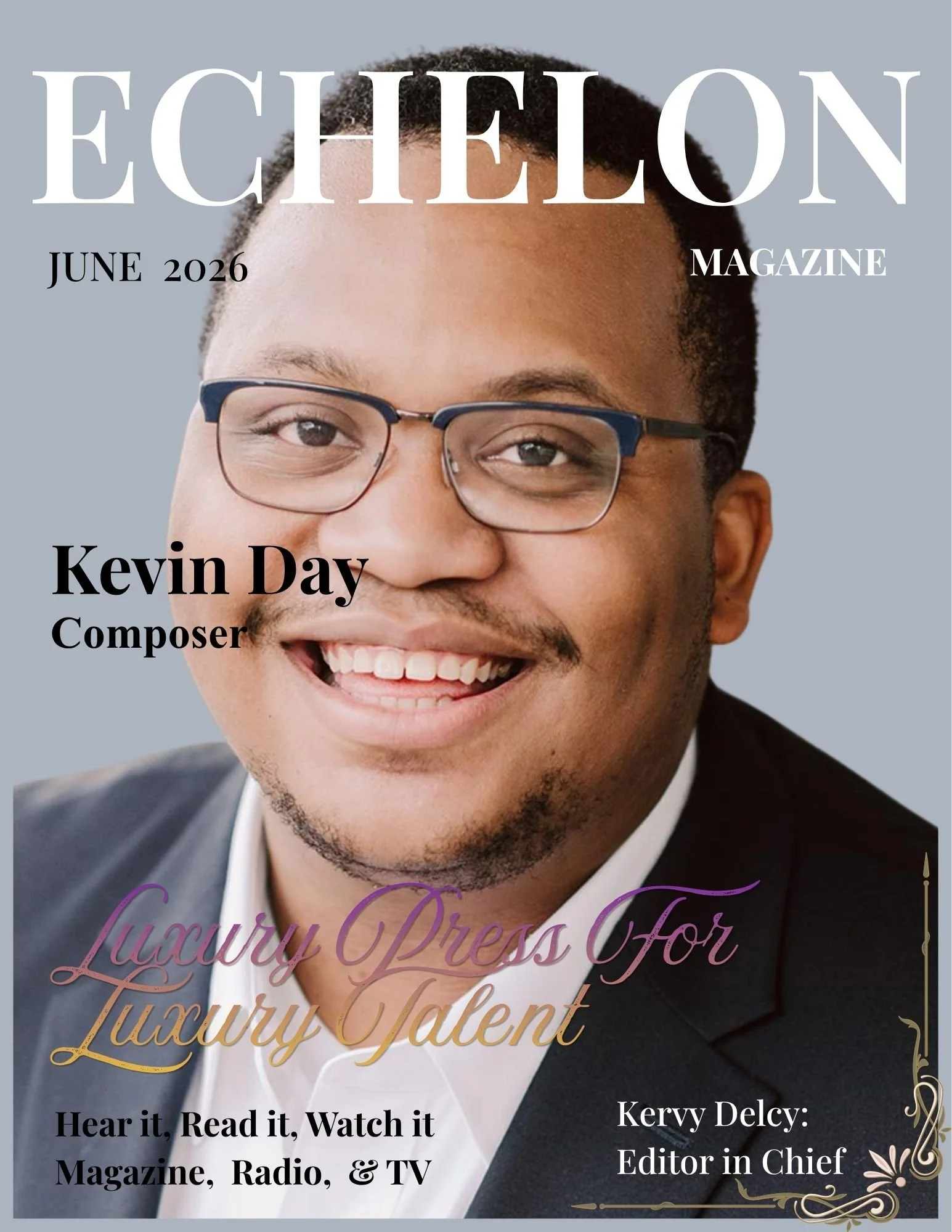
What do you hope listeners take away from your music?
"What do you hope listeners take away from your music?"
The question seemed deceptively simple. Composers spend years studying harmony, orchestration, counterpoint, rhythm, and form, yet none of those subjects truly answers why music is written in the first place. Kevin Day paused briefly before responding, not searching for the perfect phrase, but weighing the significance of the question itself.
"Some kind of feeling."
It was perhaps the shortest answer of our conversation, yet it became the one that lingered the longest. Throughout our interview, Day spoke about jazz, opera, improvisation, orchestral writing, creative process, and artistic growth, but every topic ultimately circled back to people. He spoke of audiences rather than accolades, collaboration rather than competition, and community rather than prestige. It became increasingly clear that while many listeners recognize Kevin Day for his exhilarating rhythmic language and stylistic versatility, the true center of his artistic philosophy is not rhythm at all; it is human connection.
Describing Day simply as a composer who fuses jazz and classical music would therefore be an oversimplification. His music certainly inhabits those spaces, but it refuses to remain confined by them. Improvisation, cinematic color, gospel sonorities, contemporary classical techniques, and an unmistakable rhythmic vitality all coexist naturally within his musical language. They are not displayed as influences to be recognized; they function as a shared vocabulary through which he communicates ideas that are ultimately emotional rather than stylistic.
That realization became even more apparent after spending time with one of his orchestral works.
Finding Poetry in American Pastorale
After our interview, I spent time listening to Day's American Pastorale, wanting to meet the music on its own terms before asking him to describe it. What struck me first was not only its rhythmic confidence, a quality for which he is already known, but its remarkable sense of balance.
The piece gives its ideas room to unfold without haste. Rhythmic energy rises naturally rather than forcefully, and lyricism is allowed equal space to breathe. The music moves steadily forward, but never impatiently. Instead, it draws the listener into a sound world that feels expansive, thoughtful, and quietly expressive.
Hearing American Pastorale after our conversation revealed something I had not fully
recognized at first. Day spoke repeatedly about writing music that leaves audiences with "some kind of feeling," and that philosophy is audible throughout the work. Rather than showcasing complexity for its own sake, the music communicates with striking sincerity. The orchestral writing is colorful without excess, expressive without sentimentality, and sophisticated without becoming inaccessible.
That balance may be one of Day's greatest strengths as a composer. He understands that accessibility and artistic depth are not opposing ideals. Music can be intellectually engaging while remaining emotionally direct, and American Pastorale demonstrates that beautifully, allowing craftsmanship to serve expression rather than overshadow it.
Growing Up in Sound
For Kevin Day, music was never something discovered later in life. It was the atmosphere in which he was raised.
His father worked as a gospel and hip-hop producer in the San Francisco Bay Area during the late 1980s and early 1990s, while his mother sang in the gospel church. Music filled the home long before he ever considered composing. Choir rehearsals, performances, recordings, and rehearsals formed the soundtrack of childhood, creating an environment where musical expression felt less like a profession than a way of life.
As he grew older, that musical curiosity expanded rather than narrowed. He performed in concert band, orchestra, and jazz ensemble, studying euphonium, tuba, and piano while absorbing an unusually broad range of musical experiences. Looking back, it seems almost inevitable that a composer raised among so many musical dialects would eventually reject rigid stylistic categories. Long before the word "fusion" became part of his artistic vocabulary, he had already lived it.
Ironically, composition was not his original ambition. Day entered college intending to become a performer. Yet after long days of coursework, he repeatedly found himself returning to composition, spending evenings writing music simply because he could not imagine doing otherwise. What began as curiosity gradually became conviction. Encouraged by composer Gabriela Lena Frank, whose mentorship helped him embrace composition fully, Day chose to follow the creative instinct that had quietly been growing beneath the surface. It proved to be a defining decision, one that ultimately led from wind band repertoire to orchestral music, chamber works, and increasingly, opera.
When Opera Changed the Conversation
Although rhythm remains one of the defining characteristics of Day's musical language, he readily acknowledges that his artistic voice has changed over the past several years. Much of that transformation can be traced to opera.
Writing for voices introduced new questions that purely instrumental music rarely demands. Suddenly, melody had to coexist with language. Rhythm had to accommodate breath. Orchestration became inseparable from narrative. The result, Day explained, has been a growing interest in intimacy, vulnerability, and emotional honesty.
It is an evolution that feels entirely natural. The rhythmic vitality remains unmistakably his own, yet a deeper emotional palette now accompanies it. Rather than constantly driving forward, his music increasingly allows itself moments of stillness, reflection, and tenderness. Opera has not replaced the composer listeners already knew; it has expanded him.
That same openness extends to his creative process. When confronted with artistic obstacles, Day no longer believes in forcing inspiration. Instead, he steps away from the score. Quiet walks, nature, and moments of genuine rest have become essential components of his compositional life. In a profession that often glorifies constant productivity, his perspective offers a refreshing reminder that creativity sometimes advances most profoundly through stillness.
Success Beyond the Score
Toward the end of our conversation, I asked Kevin Day how he defines success as a composer.
His answer was striking precisely because it avoided the obvious.
He did not begin with awards, major commissions, prestigious orchestras, or career milestones. Instead, he spoke about community. He spoke about collaboration. He spoke about seeing an idea that once existed only in silence transformed into living sound by musicians who believe in the work. To him, success is measured less by recognition than by realization, the extraordinary journey of watching imagination become performance.
Equally compelling was his rejection of the competitive mindset that often defines the classical music profession. Day believes composers should celebrate one another's successes rather than treat every opportunity as a contest. It is a philosophy rooted in generosity, one that recognizes artistic communities flourish when musicians invest in one another rather than compete for increasingly narrow definitions of success.
Perhaps that is ultimately what distinguishes Kevin Day, not merely the rhythmic brilliance of his writing, the breadth of his influences, or the growing diversity of his catalogue, but the humanity that informs each of those qualities. His music invites listeners not simply to admire its craftsmanship but to inhabit its emotional world. It reminds us that the most enduring compositions are rarely those that seek only to impress. They are the ones that leave us changed, however subtly, after the final note has faded.
If American Pastorale is any indication of the artistic path ahead, Kevin Day's evolution is far from complete. The grooves remain, the energy remains, and the unmistakable musical voice remains. Yet beneath them lies something increasingly profound: a composer who understands that great music does not merely occupy space in a concert hall; it occupies space in memory.
An Artist in Motion
It is tempting, particularly in classical music, to define composers by the qualities that first brought them recognition. In Kevin Day's case, that conversation often begins with rhythm, and understandably so. His command of groove, color, and musical momentum has become one of the most recognizable aspects of his compositional language. Yet to stop there would be to overlook the quiet transformation taking place beneath the surface.
Throughout our conversation, I found myself returning not to discussions of orchestration or stylistic fusion, but to the words that appeared between those subjects: vulnerability, community, rest, curiosity, and humanity. They surfaced repeatedly, revealing a composer whose artistic evolution is being shaped as much by reflection as by technique.
That is what makes this moment in Day’s career so compelling. He is not abandoning the musical language that first defined his voice; he is broadening it. His rhythmic brilliance remains, now joined by a deeper openness to stillness, narrative, and emotional vulnerability. His work increasingly asks not only how music moves, but what it leaves behind after it ends.
Listening to American Pastorale after our conversation and hearing Day reflect on his creative philosophy afterward made those connections difficult to ignore. The music and the man seemed to answer one another. What initially presents itself as confident orchestral writing gradually reveals a composer searching for something deeper than stylistic distinction. He is searching for authenticity.
There is, perhaps, no better place for a composer to be.
For listeners, Kevin Day's catalogue is compelling not only for what it has already achieved, but for the possibilities it continues to suggest. Some artistic voices arrive fully formed; others keep unfolding, revealing new dimensions with each work. Day unmistakably belongs to the latter. To follow that evolution, and more importantly to hear it, is to witness one of the most compelling journeys in contemporary American composition.