What If?
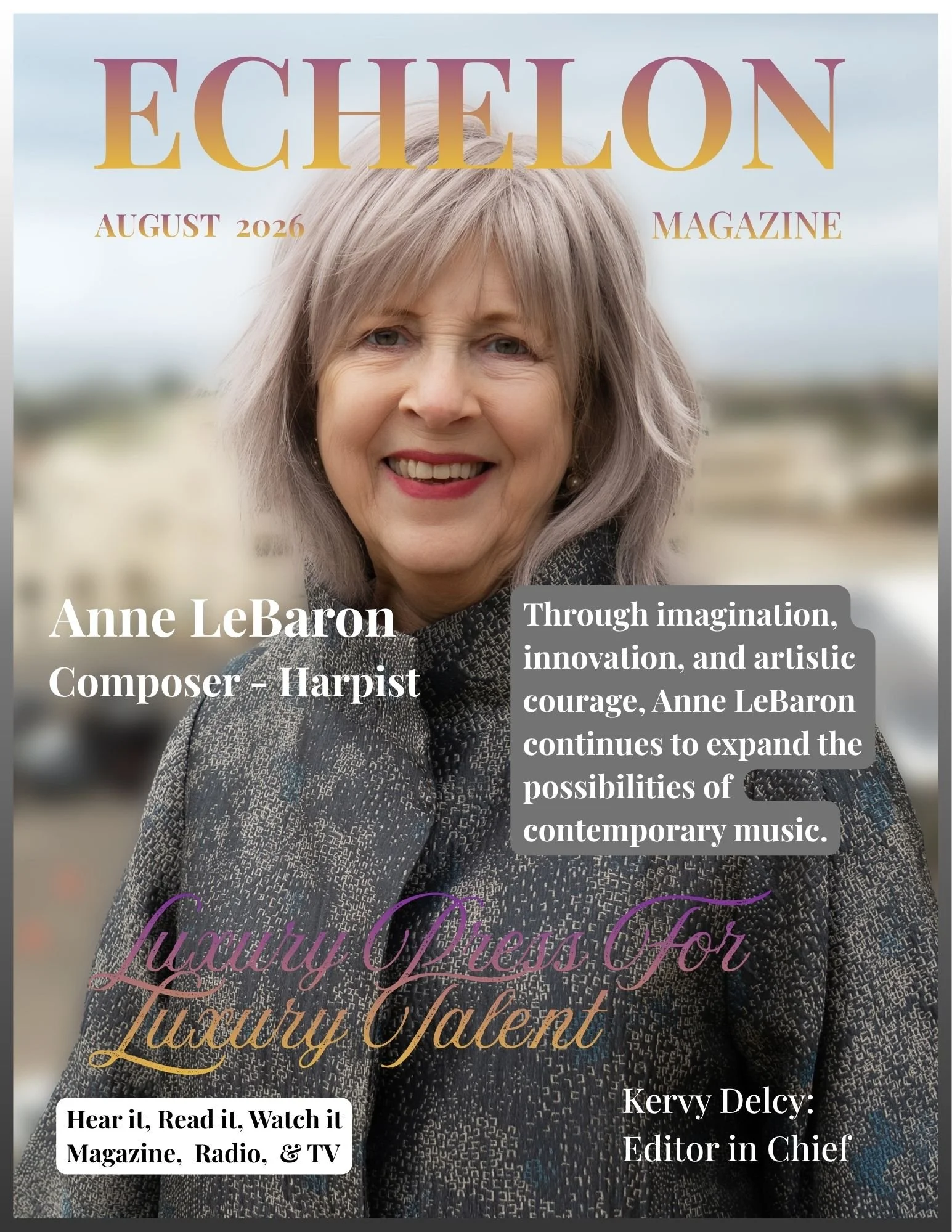
Anne LeBaron and the Sound of Radical Curiosity
The Spirit of Wonder
The blank page, for LeBaron, seems less like a surface to fill than a space to enter. She approaches it as a threshold: a listening place, a dare, a door left slightly open.
She begins with a question.
Not the practical questions that inevitably accompany every new commission, instrumentation, duration, deadlines, rehearsal schedules, but the kinds of questions that linger long after logic has exhausted itself. What does an MRI machine sound like when its rhythms are no longer perceived as machinery but as music? What if Eurydice refused to follow Orpheus back into the world of the living? Could a harp carry the memory of the haunted house from which it came? What would happen if an opera abandoned hierarchy altogether and invited composers, dancers, writers, instrumentalists, and actors to create side by side instead of following the traditional chain of command?
In LeBaron’s imagination, such questions are not ornaments placed around the music; they are the pressure from which the music begins to take shape. Spend an hour speaking with her, and it becomes clear that curiosity is not merely a prelude to composition. It is the composition’s first instrument.
Perhaps that explains why her journey into composition feels remarkably free of mythology. Unlike the familiar stories of child prodigies destined for greatness, LeBaron's path began with something much simpler. She was a songwriter before she knew there was such a thing as being a composer. Inspired by Joan Baez, the folk traditions surrounding her father, and the music that filled her childhood home, she wrote songs without imagining that writing music could become a profession. Everything changed the day she met a student who casually mentioned majoring in composition. "I didn't know you could major in composition," she recalled, laughing at the memory. Suddenly, what had seemed impossible became imaginable.
A second revelation arrived not long afterward in a university theory class. Students had been assigned to write short pieces for instruments they did not play. When LeBaron heard musicians perform one of her compositions, something shifted permanently. The realization that sounds first imagined in silence could come alive through other people felt almost miraculous. It was no longer simply about writing notes. It was about imagining worlds that other musicians could enter and make real. Looking back, she speaks of that moment with the same sense of wonder one might reserve for a life-changing discovery. It was the moment composition ceased to be an abstraction and became a calling.
Collecting Heroines
Listening to LeBaron describe her compositional process, one notices that inspiration might arrive as a concept, but often begins with a person.
Sometimes that person is someone whose name appears in history books. Sometimes she is known only to family and friends. Sometimes she has just appeared in the morning news. What unites them is not fame but courage.
Several years ago, LeBaron began an ongoing project titled The Heroine with a Thousand Faces, a response to Joseph Campbell’s The Hero with a Thousand Faces. Campbell’s book had shaped generations of artists and writers, but LeBaron was drawn to what it left out: women whose lives could not be reduced to goddesses, muses, or symbols. The project became a series of musical portraits, each one centered on a woman whose courage had taken a distinct form.
Each composition becomes a musical portrait, a brief meditation on the essence of a single life. Some honor internationally recognized figures such as Susan B. Anthony. Others remember women whose influence may never reach history books, but whose courage remains no less profound. One work grew from the memory of Finnish composer Kaija Saariaho, whom LeBaron had known personally. After reading that Saariaho had incorporated the sounds of an MRI machine into one of her final compositions while undergoing treatment for brain cancer, LeBaron found herself entering an MRI scanner for her own medical examination. Rather than hearing mechanical noise, she heard layers of rhythm, drones, pulses, and shifting textures. Where many would have heard only machinery, she recognized the beginning of another composition.
That story reveals something essential about her. Most composers transform experience into music. LeBaron transforms attention into music.
She notices what others pass by. The hidden rhythm inside a medical machine. The political force contained within a single sentence of Susan B. Anthony's speeches. The overlooked lives of women whose courage may never occupy museum walls or concert halls. Her compositions become acts of listening as much as of writing, reminding us that, for her, imagination is often the ability to recognize extraordinary possibilities already present in the ordinary.
Imagining the Impossible
If there is a thread connecting Anne LeBaron's remarkably diverse body of work, it is her refusal to accept that music should merely accompany an idea. She asks something far more demanding of herself. She wants sound to become the idea.
When she began writing her opera LSD: Huxley's Last Trip, for example, she was confronted with a question that could not be answered through conventional orchestration alone. Aldous Huxley's final hours, spent under the effects of LSD at his own request, have long fascinated artists and scholars alike. Yet LeBaron was less interested in retelling that story than in confronting a far more elusive challenge. How could acoustic instruments communicate the instability, altered perception, and strange beauty of a hallucinatory experience without relying on electronics or theatrical illusion?
Her solution required reimagining the very language of sound itself.
She turned to the extraordinary instruments created by American composer Harry Partch, whose microtonal system divides the octave into forty-three pitches rather than the twelve familiar to Western ears. Those instruments, combined with strings, piano, percussion, and clarinet, allowed her to create a sound world that feels perpetually suspended between familiarity and uncertainty. The music keeps the listener engaged even as it constantly invites them into territory that resists easy explanation. LeBaron described the result as introducing "a kind of sheen" over the music, a mysterious instability that mirrored the emotional landscape she hoped to create. It is an elegant reminder that composition, at its highest level, is often an act of solving problems no one else has yet imagined.
That same spirit of curiosity appears even in the most unexpected places.
“Hsing,” one of LeBaron's works for concert harp, began, improbably enough, with a tiny wire-strung harp rescued from a supposedly haunted house. Another composer might have enjoyed the story of the haunted harp and moved on. LeBaron transformed it into a theatrical meditation in which the harpist speaks to the instrument, audience members become participants, and chance enters the performance through a series of cards randomly drawn by the harpist, instructing performers to improvise, invite listeners onstage, or alter the course of the piece according to unexpected circumstances. The haunted harp ceased to be an anecdote. It became the seed from which an entirely new musical world emerged.
Listening to these stories, one begins to understand that LeBaron's imagination does not operate by searching for novelty for its own sake. Rather, she possesses an unusual ability to notice relationships that others overlook. A medical scanner becomes an orchestra. A classic book about a hero’s mythological journeys becomes a feminist reimagining. A child’s instrument becomes theatrical ritual. Possibility reveals itself not because she forces it into existence, but because she remains attentive long enough for unlikely connections to appear.
The Long Road Back
Not every question leads immediately to an answer.
When I asked LeBaron about failure, the conversation grew noticeably quieter.
She spoke about her first opera, The E & O Line, a bold retelling of the Orpheus and Eurydice myth. In LeBaron’s version, Eurydice refuses to return to the life she left behind. Years of creative work had culminated in what seemed destined to become a fully staged production. Musicians had been hired. Designers assembled. A theatre secured. Everything pointed toward opening night. Then, only weeks before production, one of the financial backers admitted that the promised funding had never existed. The production collapsed almost overnight.
For many artists, such a moment might have become the defining disappointment of a lifetime. LeBaron tells the story differently.
She does not deny the devastation. Even today, while organizing decades of manuscripts for UCLA's Special Collections, she admits that seeing the boxes filled with sketches and drafts reminds her of what might have been. Yet she also speaks with the calm perspective that only the passage of time made possible. Twenty-five years later, fragments of that same opera unexpectedly found new life in Russia, where they gradually expanded back into a work approaching its original scale before enthusiastic audiences. "The phoenix rises from the ashes," she said with a smile.
The phrase lingers because it captures more than the story of a single opera. It captures the spirit of an artist who has never measured success solely by immediate recognition. Some works require decades before finding the place they were always meant to occupy. Some questions demand years before revealing their answers.
The Courage to Imagine
Toward the end of our conversation, I found myself thinking less about the astonishing range of LeBaron’s compositions than about the spirit that keeps calling them into being. Forgotten heroines, ancient myths, medical technology, microtonal instruments, theatrical ritual, collaborative creation. In her telling, none of these felt like separate territories. They felt like neighboring rooms in the same house of wonder. What makes her work so moving is not only its invention, but also its openness, the feeling that she is still listening, still asking, still making room for surprise.
There is a tendency to speak of creativity as if it were a lightning strike, a sudden and solitary flash, entirely new. LeBaron’s career suggests a richer truth. Creativity, in her hands, begins with devotion to attention. It means hearing musical potential inside a machine others would only endure, sensing musical possibilities in the margins of history, and recognizing that science, myth, memory, literature, and daily life are already sounding if one knows how to listen. Her compositions do more than expand the contemporary repertoire. They enlarge the listener’s sense of what the world itself may contain.
After spending time in conversation with her, one leaves with the feeling of having been invited into a larger imagination. Her originality is unmistakable, but what feels just as rare is the generosity of that originality and the way it makes room for intellect, feeling, experiment, story, rigor and tenderness. Across five decades, she has shown that contemporary composition need not harden into abstraction. In her music, innovation remains human, curious, and alive.
What stays with me is not only the scale of LeBaron’s achievement, but the aliveness of her curiosity. She keeps returning to the places where a story, a sound, or an instrument still has something left to reveal. Her work asks us to listen with the patience to notice what is strange, unresolved, and waiting to be heard.