Diogo Carvalho: Before the Music
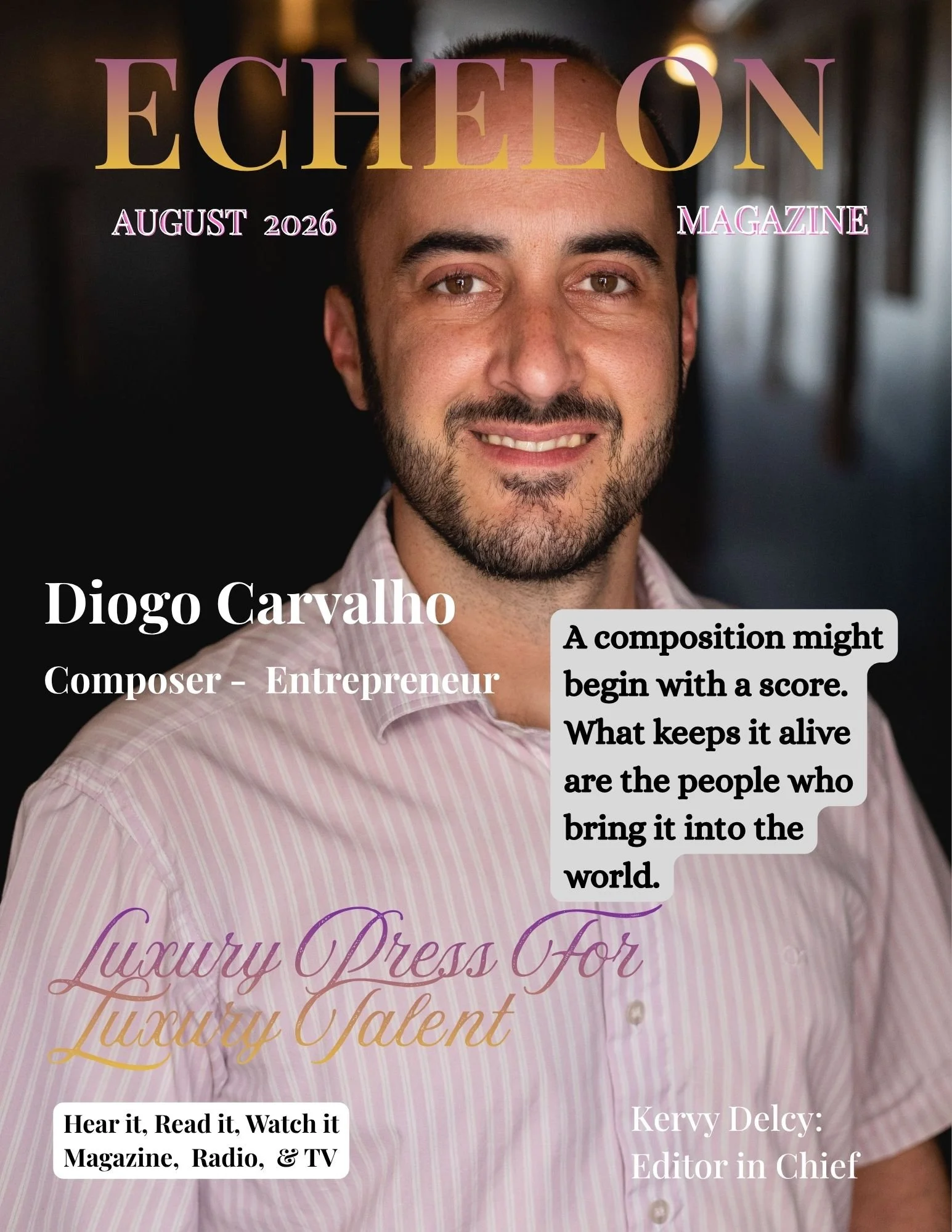
Diogo Carvalho on Composition, Community, and the Human Work Behind Art
Music Begins with People
Composers are often asked a question so familiar that many learn to answer it almost automatically: Why do you write music? Some speak of sound, curiosity, beauty, memory, or the private need to create. Diogo Carvalho answered differently. Before turning to harmony, structure, or style, he spoke about people. For him, composition is a way of entering into relationship with performers, audiences, and the specific place and occasion for which a work is written. He does not treat composing as an isolated act or romanticize the solitary artist writing toward some distant future. He wants to know where the music is going, who will play it, and who will be there to receive it. “The motivation is always through the people,” he explained. “I am writing thinking about that event.”
That answer offers an important key to understanding Carvalho’s work. His musical language is wide-ranging, Brazilian-inflected minimalism, electroacoustic writing, jazz influences, graphic structures, and a particular fascination with revealing sounds that usually remain hidden inside instruments. Yet the diversity of these approaches does not result in fragmentation. They belong to what he calls different “personas,” each one distinct but rooted in the same desire to create an experience that can be shared. Even his interest in close-miking and amplified instrumental detail carries something deeply human within it: an urge to draw the listener nearer, to reveal a breath, scrape, resonance, or vibration that might otherwise pass unnoticed.
For him, music does not become complete when the score is finished. It becomes complete when it enters a room and begins to alter the relationships inside it. That may happen in a concert hall, a classroom, a church, a neighborhood gathering, or an international festival. The scale matters less than the encounter. This philosophy also explains why he says he writes primarily for commissions or specific performance situations. The event is not merely the destination of the piece; it is part of its conception. The performers and audience are present in the work before a note is written.
There is something quietly radical in that position. Contemporary composers are often encouraged to develop a recognizable identity, accumulate performances, and pursue increasingly prestigious institutions. Carvalho does not reject professional ambition, but he places it after something more fundamental. Music must first belong somewhere. It must reach actual people in an actual place. Without that connection, the professional machinery surrounding a career begins to feel strangely incomplete.
Community Before Career
When I asked what would remain if every institution disappeared, Carvalho did not mention conservatories, competitions, or major ensembles. He returned instead to the smallest possible circle. A composer, he suggested, should write music and have it played within their own community, even if that community is no larger than a neighborhood, church, school, or local gathering place. “You have to succeed at home first before you can go to the world,” he said.
The statement is practical, but it also carries a deeper philosophy. To begin at home is to learn that music cannot demand attention simply because it has been written. It must understand the people it hopes to reach. Carvalho often tells young composers that a local choir or community ensemble will not perform a work merely to advance someone’s career. The music must mean something to them as well. It might respond to a celebration, a ritual, a shared history, or a need already present within that community. In this sense, composition becomes less about self-expression alone and more about reciprocity. The composer brings imagination but must also bring curiosity about the lives of others.
That same conviction has grown into work that now spans continents. Through Global Arts United, Carvalho has helped build a platform for festivals, educational exchanges, concerts, tours, and cultural programs designed to connect artists, audiences, donors, and institutions across borders. His own biography helps explain the scope of that work: born in São Paulo, he has moved fluently among composition, performance, scholarship, teaching, and arts administration, with music that draws on electroacoustic practice, Brazilian traditions, jazz, and concert forms. The result is not simply a résumé of international activity, but a pattern of cultural mediation, one in which artistic creation is inseparable from the practical work of making encounters possible.
His current and recent initiatives make that philosophy concrete. Global Arts United identifies its mission as “bringing people together through the arts,” and its programs include international festivals, educational exchange, cultural events, and support networks for artists. The Thessaloniki Art and Music Summit, organized by Global Arts United in partnership with ABLAZE Records, brings composers, visual artists, ensembles, and the Thessaloniki State Symphony Orchestra into a two-week environment of performances, workshops, rehearsals, and cultural immersion. Similar projects in places such as Sofia place young artists in direct contact with professional orchestras and historic cultural institutions, turning the idea of community into a lived artistic process.
The Lessons Students Take with Them
Although Carvalho's career has moved through concert halls, universities, museums, and international festivals, he speaks about teaching with the same urgency he brings to composing. The classroom is not a retreat from artistic life; it is another form of composition, one made from attention, example, and trust. To teach young composers is to help them hear more than sound. It is to help them recognize the conditions that allow art to enter the world: discipline, patience, collaboration, and the courage to remain open to people unlike oneself.
That perspective explains why his students are not encouraged to think only as composers. They are asked to understand the ecology of the profession they hope to enter. Writing compelling music is essential, but it is only one part of a larger artistic intelligence. Young artists must also learn how to communicate clearly, organize projects, build relationships without treating them as transactions, and recognize opportunities that may not arrive in the traditional form of commissions or academic appointments. Music, Carvalho believes, exists within communities, institutions, friendships, and shared experiences, all of which require care long before they require talent.
Perhaps this is why he measures success differently from many artists. Rather than focusing exclusively on performances, publications, or appointments, he returns to the relationships that continue after an event has ended. A festival lasts only days, but a mentorship may last decades. A rehearsal eventually closes, yet the people who shared it often remain connected throughout their careers. In Carvalho's view, those continuities are not incidental benefits of musical life. They are among the most serious outcomes music can produce.
Remembered Through Relationships
Toward the end of our conversation, I asked Carvalho how he hoped to be remembered. The question might have invited a list of landmark works, influential publications, or prestigious appointments. His answer moved in an entirely different direction: he hopes people will remember the person behind the work.
He spoke about conversations, friendships, students, and collaborators with a sincerity that made clear this was not a carefully prepared answer but a deeply held conviction. Compositions, he acknowledged, belong to history. They may continue to be performed, or they may gradually disappear from the repertoire. That uncertainty has never troubled him as much as another possibility: leaving behind a career without leaving behind meaningful human relationships.
There is something quietly refreshing about that perspective. The classical music world often celebrates permanence. We speak of legacies, monuments, canons, and works that will endure for centuries. Carvalho does not dismiss those ambitions, but he gently redirects our attention to something less visible and perhaps more enduring. Before a lasting artistic legacy can exist, there must be generosity. Before influence can take hold, there must be mentorship. Before music has the power to change a life, people must first encounter one another.
That belief also shapes the advice he offers younger composers. Rather than urging them to imitate established careers or chase recognition as quickly as possible, he encourages them to remain curious, patient, and engaged with the communities immediately surrounding them. Careers, he reminds them, are rarely built overnight. They grow through consistent work, genuine relationships, and a willingness to contribute long before expecting recognition in return. In many ways, it is the same philosophy that has guided his own journey, from São Paulo to international stages, from the classroom to the podium, and from composing individual works to creating opportunities for countless other musicians to share their own voices.
Listening to Diogo Carvalho, one begins to realize that his career cannot be measured solely by concerts, publications, or festivals, impressive as they may be. His compositions have traveled widely. His research has crossed continents. His festivals have brought together musicians from different cultures, languages, and artistic traditions. Yet these accomplishments seem almost secondary to the principle that quietly unites them all.
Creating a festival and composing a piece of music may appear to be different kinds of work. Carvalho sees little distinction between them. One begins with a blank page, the other with an empty room. Both become meaningful only when people gather around them.
For Carvalho, music has never been an end. It is a meeting place. Every score is an invitation. Every rehearsal is the beginning of a conversation. Every festival is an opportunity for strangers to become colleagues, colleagues to become friends, and friends to discover new reasons to keep creating together.
Perhaps that is why, after spending time with Diogo Carvalho, the question no longer seems to be why he writes music.
The more interesting question is why he continues to bring people together.
The answer, it seems, is that for him the two have never been separated.