Augusta Read Thomas: Poet of Light and sound
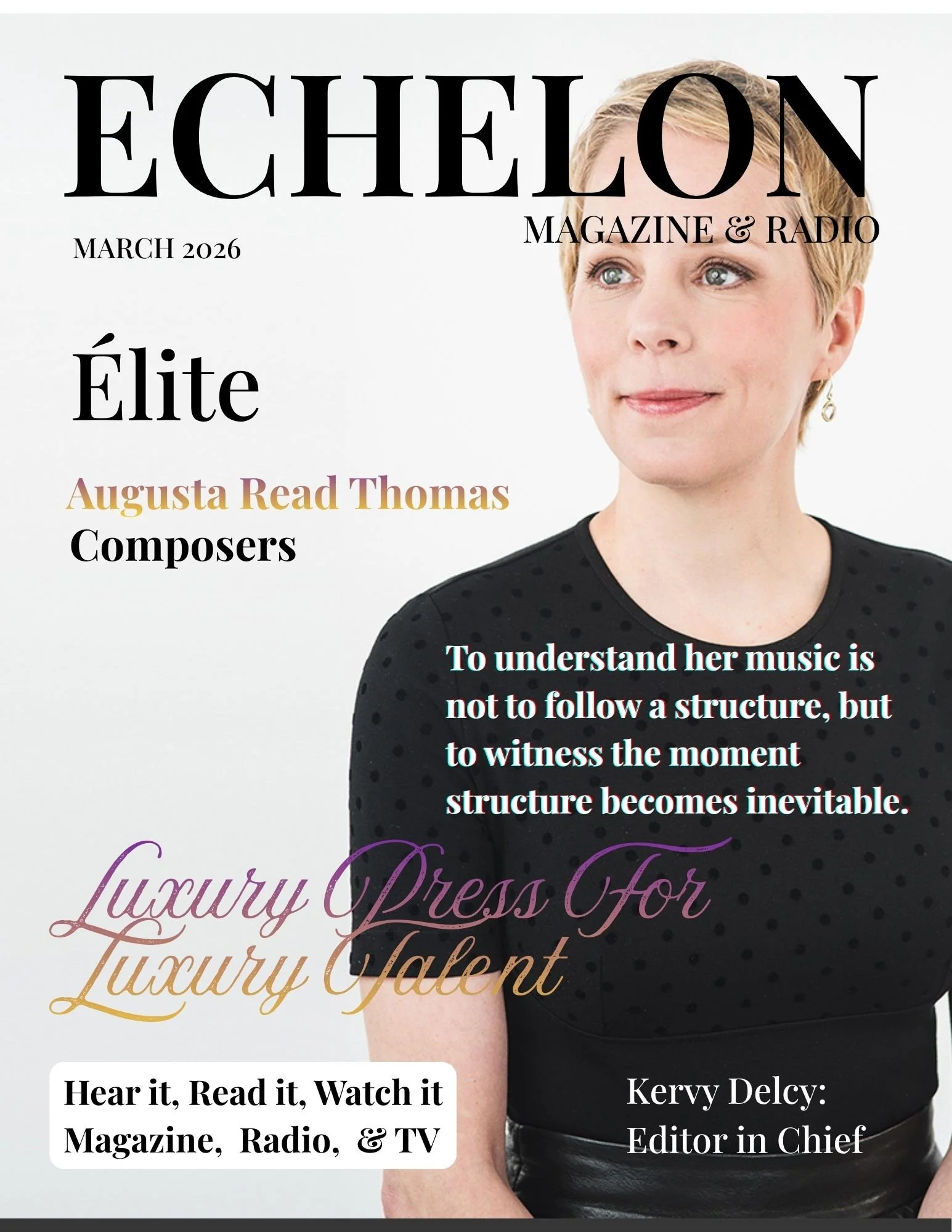
To understand her music is not to follow a structure, but to witness the moment structure becomes inevitable.
There are composers who construct music, and there are those who discover it, who listen so intently to the inner life of sound that form itself begins to reveal its own necessity. Augusta Read Thomas belongs unmistakably to the latter. Her music does not begin with imposed architecture, but with an act of immersion: an improvisation at the piano, a fragment sung into the air, a fleeting gesture that is immediately tested, reshaped, and often discarded. “Throw it out,” she insists to herself, again and again, not as rejection, but as refinement. What remains is not accidental; it is inevitable.
This process of continual emergence defines her artistic ethos. Thomas composes not by outlining form in advance, but by allowing the material to generate its own gravitational field. Each work possesses what might be called an internal orbit, a system of relationships so intricately balanced that the piece unfolds as a natural consequence of its own existence. Form, in her music, is never decorative. It is organic, responsive, alive.
At the core of this evolving architecture lies a profound engagement with motivic transformation and rhythmic syntax. For Thomas, rhythm is not merely a temporal device but a generative force, capable of shaping perception, directing energy, and sculpting musical space. Motives do not simply recur; they mutate, refract, and proliferate, creating a language that is at once rigorous and fluid. The listener is drawn into a world where continuity and change coexist in a delicate equilibrium.
At the Edge of the Universe: A Language Evolving
Equally striking is her command of harmonic language, an idiom that has matured over more than five decades of creative work yet retains a singular identity. There is a recognizable luminosity in her sound, a clarity that persists even as she ventures into ever more complex harmonic territories. She speaks of composing “at the edge of the universe,” and indeed, her music often feels as though it is reaching outward, probing the limits of resonance, color, and perception.
For Thomas, harmony, timbre, color, and gesture are inseparable dimensions of a unified sonic experience. She hears music not only as sound, but as texture, as light, as motion. Her orchestration reflects an almost microscopic sensitivity, which she describes as a “very local” system of hearing. Each pitch is assigned with intention; each instrument is chosen with precision. She can hear, in advance, the exact color of a single note within a complex fabric, and from this acute awareness emerges a palette of extraordinary richness.
Density, in her music, is never arbitrary. It is meticulously calibrated, shaped with the care of a sculptor who understands both mass and space. Even in moments of great intensity, there is transparency, a sense that every layer has purpose, every voice a role within the whole. This balance between complexity and clarity is one of the defining features of her work.
Her creative world is expansive. From opera and ballet to orchestral, chamber, and solo works, her catalogue reflects an unbounded curiosity and an unwavering commitment to exploration. She is inspired by anything that produces sound, and this openness infuses her music with a sense of vitality that is both immediate and enduring.
The human voice occupies a particularly profound place in her thinking. “The human voice is one of the most profound carriers of meaning,” she observes, and her approach to vocal writing reflects a deep sensitivity to its physical and expressive dimensions. She gravitates toward open vowels, attentive to the resonance of the throat, to the way sound is shaped within the body. In her vocal works, language is not merely set; it is transformed, elevated, and illuminated.
Collaboration as Philosophy
Collaboration, for Thomas, is not an afterthought but an essential component of creation. She engages performers with an unusual depth of empathy, often embedding questions directly into the score, inviting reflection, dialogue, and shared discovery. By the time rehearsals begin, the music has already initiated a conversation. What she seeks in performers, sympathy, kindness, and grace, are not only artistic qualities but human ones. In her world, the ethics of collaboration are inseparable from the aesthetics of sound.
And yet, in an era defined by self-promotion, Thomas remains resolutely committed to a different philosophy. She does not market her work; she does not pursue performers. Instead, she allows the music to speak with its own authority. Musicians encounter her work and are compelled to engage with it, to bring it into their own artistic lives. It is a rare and powerful testament to the integrity of her voice.
Her achievements are extraordinary. A composer whose works have been recognized and performed by luminaries such as Pierre Boulez and Daniel Barenboim, she has secured a place among the most significant musical voices of her time.
Her tenure as Composer-in-Residence with the Chicago Symphony Orchestra resulted in a series of landmark works, including Astral Canticle, a finalist for the Pulitzer Prize. Her influence extends far beyond her compositions: as a teacher, mentor, and founder of the Center for Contemporary Composition at the University of Chicago, she has shaped the landscape of contemporary music for generations.
Critics have described her music as “nuanced, majestic, elegant, capricious, lyrical, and colorful,” a body of work that “embodies unbridled passion and fierce poetry.” These descriptions, while accurate, only begin to capture the depth of her artistry. For Thomas is not merely a composer of sound, she is a composer of experience, of perception, of light itself.
Indeed, light serves as one of her central metaphors. She speaks of her work as an act of refraction, of building, sculpting, and illuminating musical materials so that they shimmer with clarity and resonance. This metaphor is not incidental; it is foundational. Her music does not obscure; it reveals. It invites the listener to perceive more acutely, to hear more deeply, to experience sound as something both tangible and transcendent.
For young composers, she offers guidance that is as practical as it is profound: cultivate imagination, develop a robust technical toolkit, maintain a disciplined work ethic, and care for one’s health. Underlying these principles is a deeper truth: composition is not a static craft, but a dynamic, lifelong practice. For Thomas, it is also a form of therapy, a daily act of engagement with the world, with oneself, with the infinite possibilities of sound.
The Music That Writes Itself
“I feel as if the piece wrote me,” she has said. “My music has its own inner life.” In this statement lies the essence of her philosophy. To compose, for Augusta Read Thomas, is not to impose will upon material, but to enter a dialogue with it, to listen, to respond, to shape, and ultimately, to be transformed.
In an age of noise, her music offers something rare: clarity without simplicity, complexity without obscurity, and above all, a profound sense of purpose. It is music that does not merely exist; it resonates, illuminating the space between sound and silence, between thought and feeling, between the known and the possible.
At a time when so much music seeks to define itself through category or convention, Augusta Read Thomas offers something far more enduring: a body of work that resists containment and insists on its own terms. Her music does not follow, it leads, illuminating a path where imagination, rigor, and humanity converge. It does not conclude, it resonates, leaving behind not answers, but possibilities.