Nisan Ak: Building the Table Where Music Learns to Breathe
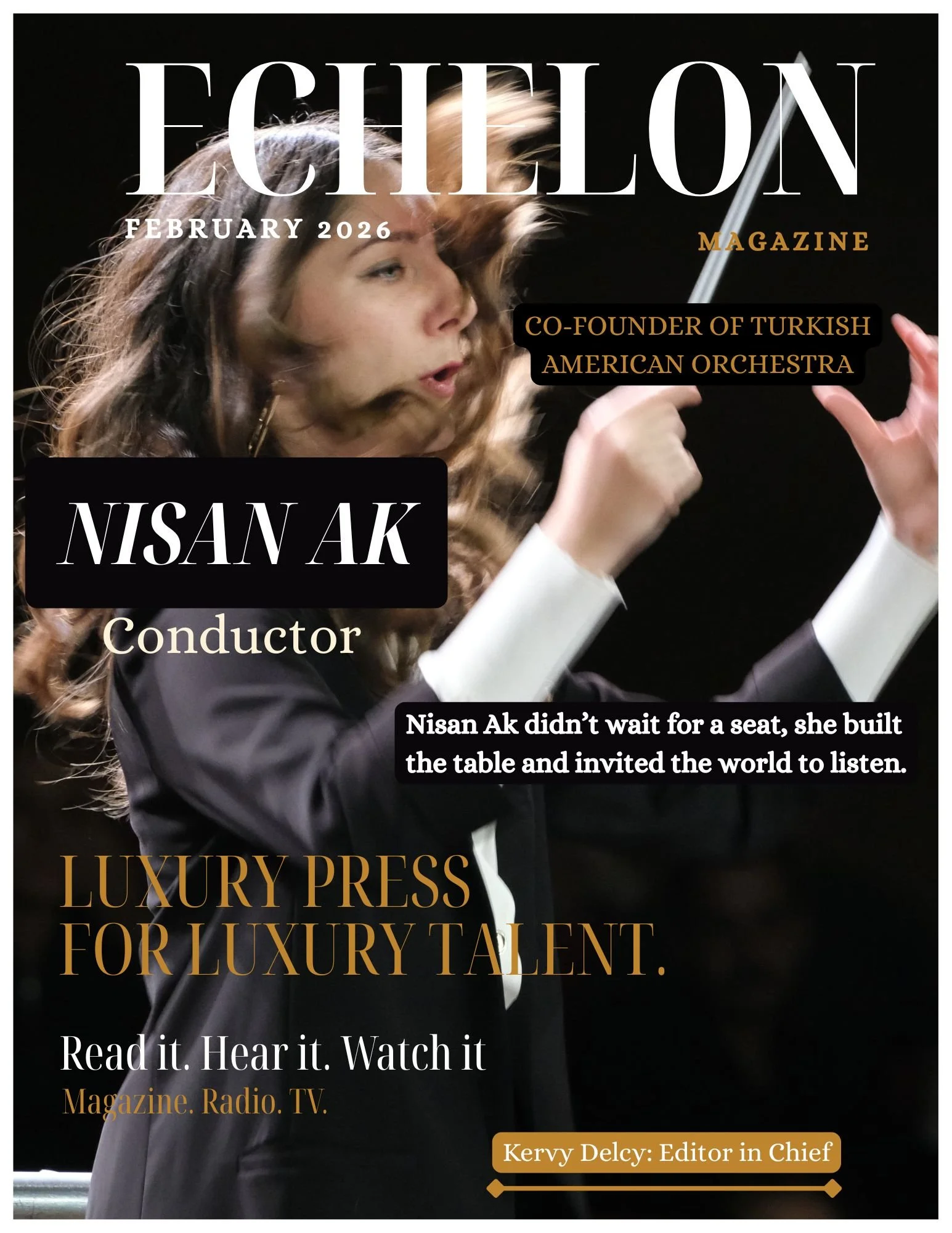
Rather than waiting for a seat at someone else’s table, she built one.
Some people arrive in music through inheritance, through last names heavy with history, through conservatories already expecting them. Others arrive the way travelers arrive in a new land: with instinct, hunger, and a willingness to learn the terrain while walking it.
Nisan Ak belongs to the second lineage.
Her story does not begin in a concert hall, but in a moment of quiet audacity. As a young girl in middle school, she wanted to sing, to belong to a choir filled with girls she admired. When she approached the choir director, she was asked if she played guitar and could accompany the group. She said yes. Not because it was true, but because it could become true.
There was a guitar at home. That was enough.
In the days that followed, she asked her mother if she could learn the instrument quickly, urgently, as if learning were a matter of survival. She joined the choir not as an observer, but as a participant. That instinct, to step forward before certainty, to learn in motion rather than wait for readiness, would quietly define the arc of her life.
Music, for Nisan, was never ornamental. It was directional.
She began with classical guitar, moved to piano, and eventually discovered composition as a way of shaping sound into thought. She studied composition formally, learning how music can carry memory, structure emotion, and hold contradictions without resolving them too quickly. But conducting entered her life not as an ambition, but rather as a consequence of leadership already present.
While conducting fellow students’ projects during a concert, someone in the audience turned to her teacher and remarked that if Nisan wanted to grow as a conductor, she was invited to attend classes at a local conservatory. Later, at a workshop at Queens College, her presence on the podium spoke for itself. She was invited back the following year to pursue conducting formally.
Conducting, she would later explain, is a uniquely exposed art form. Painters can revise in private. Writers can erase. Composers can sit in silence until it yields. Conductors, however, make their mistakes in public, standing before musicians, shaping sound in real time, accountable not only to the score but to human trust. The greatest challenge for young conductors is not talent, she often notes, but access. Podium time. The permission to try and fail, again and again, in front of an orchestra. Too often, that space is withheld.
So she created her own.
Immigrating to the United States, Nisan encountered a musical landscape rich with possibility and rigid with tradition. The doors were not always closed, but they were not always open either. And she understood something essential early on, waiting can be its own form of erasure.
Rather than waiting for a seat at someone else’s table, she built one.
The Turkish American Orchestra emerged not as a response to absence, but as an act of authorship. Founded from scratch in New York City, it stands today as the only orchestra in the United States dedicated specifically to Turkish music, yet it refuses narrow definitions. Under Nisan’s leadership as co-founder and music director, the orchestra is not confined by nationality or nostalgia. It is expansive, porous, and alive.
Its repertoire moves fluidly from Ottoman classical traditions to contemporary works, from familiar harmonic language to textures that surprise the ear. Turkish music is not presented as artifact, but as living material, capable of dialogue, friction, and reinvention. Importantly, the orchestra is not limited to Turkish composers. Instead, it operates as a true cultural meeting ground.
The ensemble’s composers-in-residence and collaborators come from diverse backgrounds, including the Caribbean, reflecting a belief that cultural advocacy gains strength through generosity rather than gatekeeping. In a single concert, one can hear multiple timbres, histories, and emotional grammars, sounds that do not cancel one another out, but coexist.
Here, the orchestra becomes a metaphor: a society that listens.
Nisan’s leadership is neither loud nor passive. It is intentional. She does not posture against tradition, but she does not bow to it either. She reshapes it from within, asking what music can become when power is shared and curiosity is centered.
Her work insists that representation is not symbolic; it is structural.
Recognition followed, though it was never the goal. In 2019, she was named to Forbes Türkiye’s 30 Under 30 list, recognized as one of the most versatile conductors of her generation. She has conducted across the United States and internationally, including performances in San Francisco, Miami, Charleston, Quebec, Bursa, Ankara, and Antalya. Her Carnegie Hall debut in 2021 marked not an arrival, but a continuation. In the 2023–24 season, she appeared with the Borusan Istanbul Philharmonic and the Antalya State Symphony Orchestra.
Yet the podium is only one dimension of her work.
Nisan is also an educator and a translator of ideas, someone who understands that music survives only if it is spoken about, taught, and reimagined. She teaches at the College of Charleston and reaches global audiences through educational platforms such as TEDx, TRT Müzik, YouTube, and BorusanSanat TV. Her collaborations with brands like Kiehl’s, Doritos, and Mercedes-Benz are not endorsements of glamour, but strategic acts of visibility, placing classical music and women’s leadership in spaces that do not traditionally hold them.
Born in Istanbul, she holds degrees from Istanbul Bilgi University, the City University of New York at Queens College, and the University of South Carolina. Today, she lives between
countries, cultures, and sonic worlds, carrying with her the understanding that belonging is not always given, but constructed.
Nisan Ak’s story is not about overcoming obstacles in a dramatic arc. It is quieter, and perhaps more radical than that. It is about choosing motion over permission. About building infrastructure where none existed. About believing that if the room does not yet exist, you can still begin setting the table.
In her hands, the baton is not a symbol of authority; it is an invitation.
And the orchestra, under her direction, becomes something more than sound. It becomes proof that when women, immigrants, and visionaries stop waiting to be included, the music changes. The air changes. The future listens.
Nisan Ak belongs in the spotlight not because it was handed to her, but because she learned how to carry her own light. Her journey is shaped by courage, the kind that says yes before certainty, that builds without waiting for permission, that risks missteps in order to move forward. She chose motion over fear, curiosity over comfort, and in doing so, carved space where none existed before.
Her leadership is not loud, but it is resolute. It lives in her willingness to stand on the podium, to gather people from different worlds, and to trust that something meaningful will emerge when they listen to one another. By walking an uncharted path, she has quietly widened it for others, reminding us that tradition is not something to be preserved untouched, but something to be lived, questioned, and reimagined.
Nisan’s voice rises from difference, from migration, from the courage to begin again in a new land. It is a voice that does not ask to be included; it arrives fully formed, generous in spirit, and open in vision. In creating her own table, she has invited many to sit, and in doing so, has shown that the future of music belongs to those brave enough to lead it before they know where it will land.