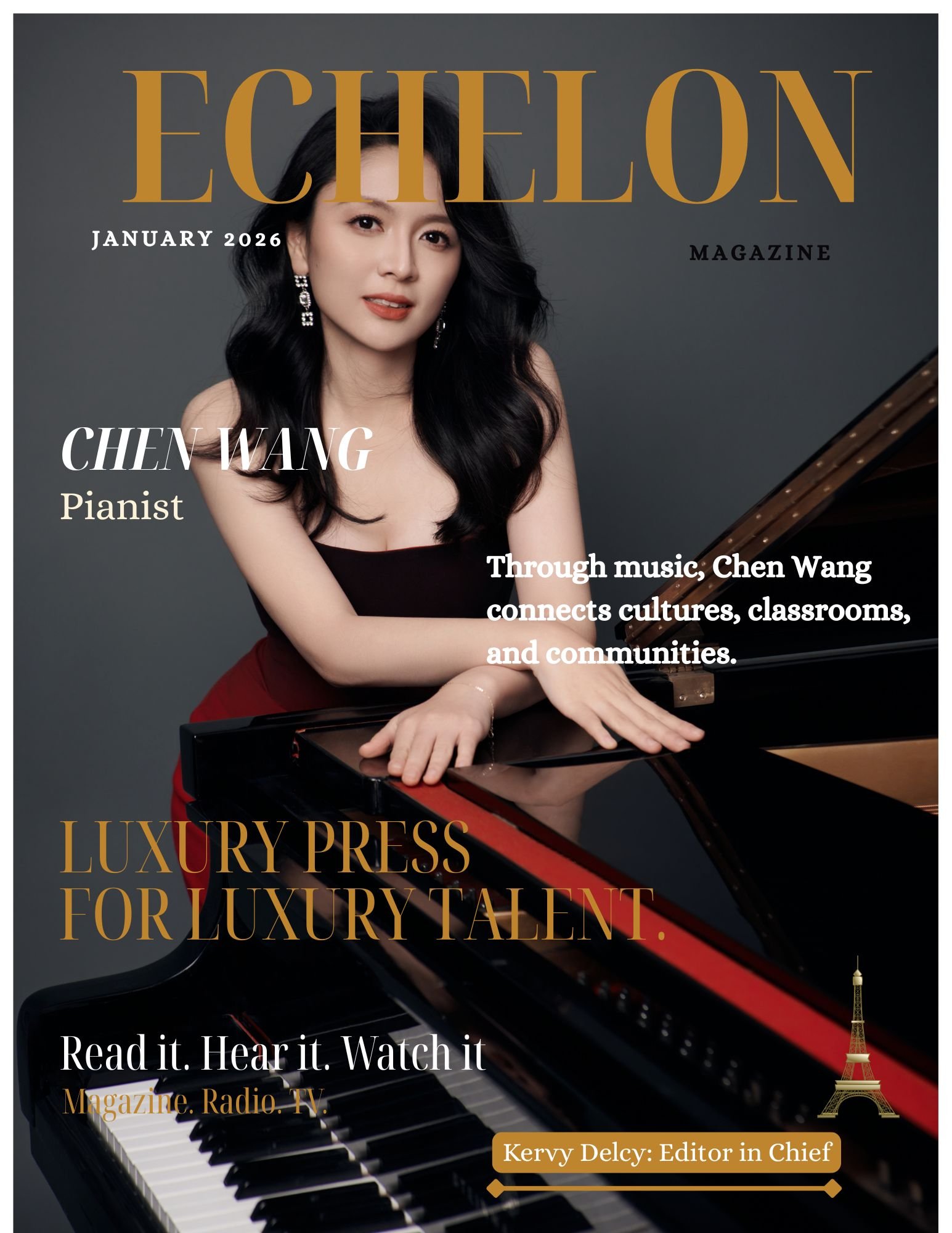
Chen Wang: The Pianist as Cultural Diplomat
Early Encounters with Music
Chen Wang’s journey with the piano began at the age of five, when a simple encounter with her kindergarten teacher’s playing ignited a spark. Unlike casual childhood hobbies, this fascination would grow into a lifelong devotion. Her parents, cautious yet encouraging, insisted she think seriously about the commitment it would require. A year of reflection and persistence later, Wang began formal piano lessons, a decision that marked the start of a life intertwined with music.
As Wang grew, she began to realize that music had a power beyond self-expression. In middle school, she directed a fundraising concert for the 2008 Sichuan Earthquake, raising $220,000 for victims. Witnessing the impact of her musical initiative opened her eyes to music as a tool for social engagement. Later, during high school, she encountered two blind twin pianists. Their fluidity and sensitivity to music inspired Wang to teach at schools for blind and deaf students, revealing the profound ability of music to bring joy and confidence to lives otherwise shaped by limitation. These early experiences set the foundation for what would become Wang’s lifelong mission: to combine artistry with purpose, blending performance, education, and social impact.
Formative Training and Artistic Growth
Wang’s pursuit of mastery was rigorous. From her early years, she traveled extensive distances to study with prominent instructors, often enduring 20-hour weekly round-trip journeys from Zhengzhou to Beijing. These grueling commutes taught her patience, self-discipline, and an understanding that true artistry requires perseverance.
Her path was not without obstacles. When she auditioned for her dream school, she was not accepted into the piano performance division but instead into percussion, a challenge that forced her to reconsider her approach to artistic identity. Rather than abandon her ambition, Wang embraced the opportunity, finding ways to integrate multiple disciplines. Her time balancing piano, percussion, academic coursework, and language exams further reinforced the need for efficiency, planning, and resilience, qualities that continue to shape her practice and performances today.
Wang’s higher education included advanced studies at the New England Conservatory, the Middle School Affiliated to the Central Conservatory of Music in Beijing, and Columbia University, culminating in a Doctorate in Piano Performance. Her studies under acclaimed teachers, including Stephen Drury, Deborah Moriarty, and Panayis Lyras, instilled in her a philosophy that combines technical precision with mindfulness and interpretative depth. Drury taught her to immerse completely in the music, Moriarty inspired reflection on music as a mirror of universal cycles, and Lyras emphasized careful attention to details, dynamics, and the art of silence. These lessons cemented Wang’s belief that the technical and emotional dimensions of music are inseparable.
Artistic Voice and Musical Philosophy
Wang’s musical voice as a pianist is reflective, narrative-driven, and deeply connected to her audiences. She emphasizes clarity, natural flow, and emotional resonance without forcing interpretation. For Wang, a performance is not merely an individual endeavor but a shared experience, a conversation between performer and listener, between cultures, and even across generations.
Her repertoire selection reflects this philosophy. She balances traditional classical works with contemporary compositions and cross-cultural projects. In 2024, she collaborated with the Shanghai Philharmonic Orchestra for the world premiere of Jasmine Flower, a concerto reimagined from an Eastern folk song. This project exemplifies Wang’s approach: connecting tradition with innovation while engaging audiences in new ways.
Wang is particularly drawn to Beethoven’s music, which she sees as a reflection of life’s struggles and triumphs. She values pieces that allow for reflection, subtlety, and storytelling, believing that music has the power to communicate complex human emotions and shared experiences. Through phrasing, breathing, and careful attention to emotional pacing, she crafts long musical lines that guide listeners on an immersive journey.
Performance as Service
Beyond technical mastery, Wang views performance as a form of service. She has performed at major venues including Carnegie Hall, the Concertgebouw, Jordan Hall, and the National Center for the Performing Arts of China, as well as festivals such as the Asian Music Festival, SCIPP Festival, and Musique 21. Her concerts frequently integrate elements of cross-cultural collaboration, combining Eastern and Western musical traditions, classical repertoire, and contemporary innovations.
In 2022, Wang launched the Journey to Love and Peace concert series at Carnegie Hall’s Zankel Hall, a project designed to bring messages of hope and global connection in the wake of the pandemic. The series received international acclaim, with coverage in over 60 countries and recognition from both the U.S. Congress and the Mayor of Boston. The project has since expanded globally, including a world-first Metaverse recital in 2024, which merged virtual technology with live performance, demonstrating her innovative approach to connecting audiences in unprecedented ways.
Through these initiatives, Wang has consistently used her artistry to serve larger communities, emphasizing that music is not only about personal expression but also about contributing to a shared cultural and social dialogue.
Teaching and Mentorship
Wang’s commitment to music education is as strong as her performance career. As a Piano Instructor and Arts Education Program Manager at Columbia University, she mentors students from diverse backgrounds, emphasizing both technical skill and personal growth. She fosters environments that encourage inclusivity, collaboration, and cultural sensitivity, guiding students to develop discipline, creativity, and confidence.
Her students have been admitted to top conservatories and universities, including New York University, Columbia University, Harvard University, and the University of Michigan at Ann Arbor. Wang also integrates cross-cultural exchange opportunities, helping students explore and research music in international contexts, particularly in China. She sees teaching as an extension of performance: both require presence, communication, and the ability to inspire transformation.
Leadership and Cultural Diplomacy
Wang’s impact extends beyond music into leadership and cultural diplomacy. She serves as CEO and Chair of the Arts & UN Main Representative for the Young Global Leadership Foundation, an organization with UN ECOSOC Special Consultative Status. She is Vice Chairman of the Australian International Culture Industries Association. She represents artistic leadership in numerous forums, including UNESCO Peace Festivals, the Buffett Shareholders’ Meeting, and the Boao Forum in China.
Her leadership demonstrates that artists can play critical roles in fostering global dialogue. By integrating performance, education, and social engagement, Wang promotes cross-cultural understanding, empowers youth, and advocates for the arts as a force for meaningful change. She has spoken at the Metaverse Women’s Summit, encouraged women worldwide to pursue their passions, and used music to support social causes such as the COVID-19 response and education for marginalized communities.
Through these efforts, Wang exemplifies the modern artist as both a creative and civic leader, leveraging her talent to inspire and unite diverse communities.
Women in Music and Artistic Responsibility
As a woman in classical music, Wang recognizes both challenges and opportunities. The field remains shaped by historical biases, evolving audience expectations, and technological shifts. She sees her role as a performer, educator, and cultural ambassador as an opportunity to elevate women’s voices and foster inclusion.
Wang draws inspiration from figures such as Clara Schumann and Martha Argerich, whose perseverance and expressive individuality exemplify courage, artistry, and authenticity. She believes that women in music can create transformative experiences not only on stage but also in mentorship, leadership, and cultural engagement. Wang’s own career illustrates this vision:
integrating classical music with global social impact, technology, and cross-disciplinary collaboration.
Collaboration and Global Dialogue
Collaboration is central to Wang’s artistic philosophy. She thrives in musical dialogue, whether with orchestras, soloists, or students. Projects like the Journey to Love and Peace series, performances at Columbia University, and international residencies emphasize the importance of listening, responding, and co-creating.
These collaborations reinforce Wang’s conviction that music transcends personal expression. It is a platform for empathy, innovation, and shared understanding. She encourages her students to embrace this perspective, cultivating skills that extend beyond technical proficiency: leadership, cultural literacy, adaptability, and the capacity to inspire change through the arts.
Future Directions and Artistic Vision
Looking ahead, Wang continues to explore the intersections of performance, education, and cultural diplomacy. She is preparing new solo projects, including a piano album featuring Tchaikovsky’s Seasons and Beethoven’s Piano Sonata Op. 22, which reflects her interest in the cycles of nature and the flow of time. She is expanding her global educational initiatives and continues to integrate technology, culture, and innovation into her work.
Her philosophy remains consistent: music is a living, evolving force, capable of bridging differences, fostering understanding, and inspiring action. Through performance, teaching, and leadership, Wang embodies the belief that an artist’s role extends far beyond the concert hall.
Conclusion
Chen Wang’s life and career exemplify the power of music as both a personal expression and a global connector. From her earliest piano lessons in China to international concert halls and the virtual realm of the Metaverse, she has shown that artistry can coexist with leadership, mentorship, and social impact. Her work demonstrates that music is more than notes and technique; it is a force for empathy, understanding, and meaningful change. As a performer, educator, and cultural diplomat, Chen Wang continues to inspire, uplift, and unite audiences and communities around the world.