PAOLO MARCHETTINI AND THE LIVING LANGUAGE OF MUSIC
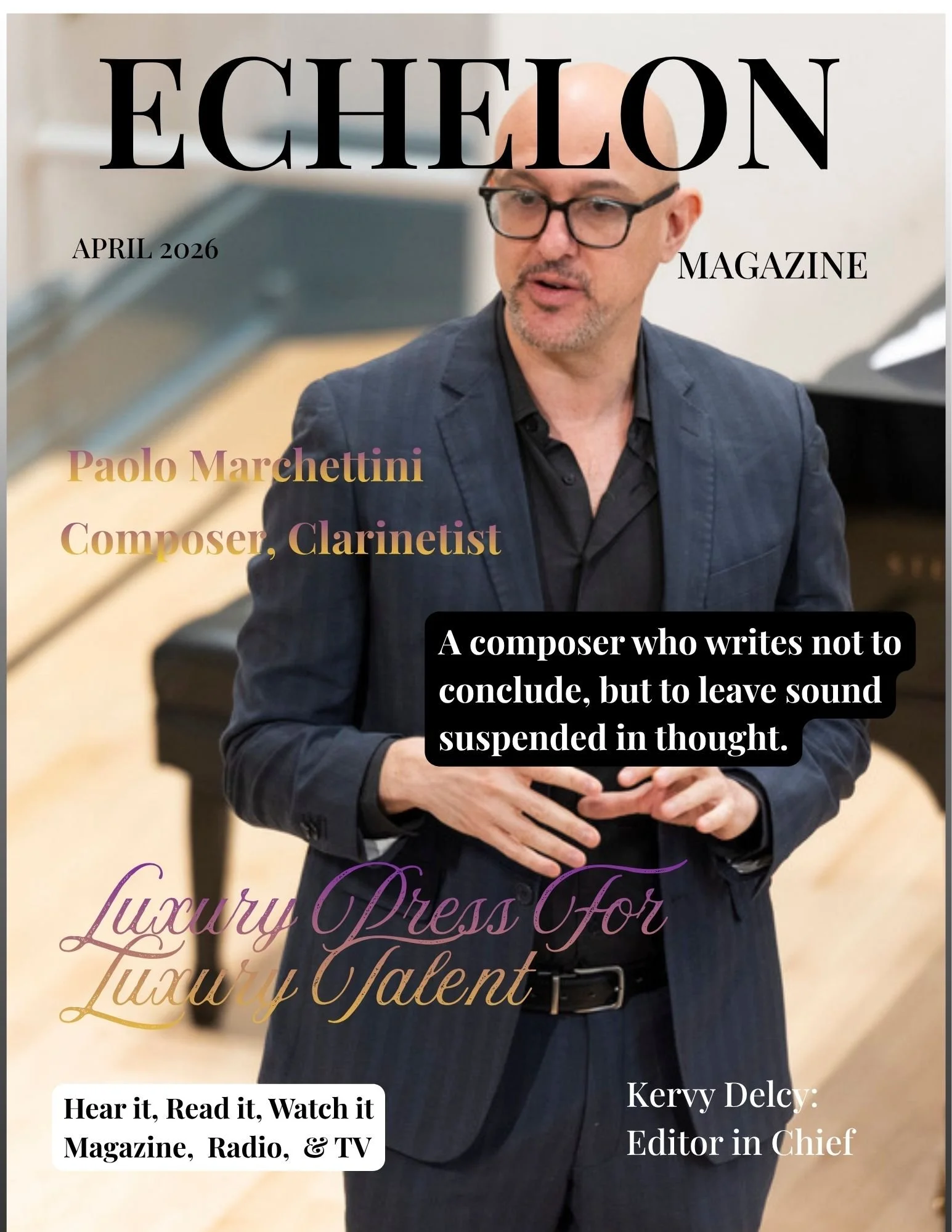
A Voice That Refuses Finality
Music that resists premature resolution does not move toward fixed meaning, but unfolds against the pressure to conclude or define. This is the case in Paolo Marchettini’s work.
To encounter his work for the first time is not to receive a fixed statement, but to enter a space of unfolding, one shaped as much by intuition as by design, and guided by a persistent search for something deeper than surface coherence. His music does not present itself as an answer. It lingers as a question.
“I like to create music which is out of time,” he explains. “Not following fashion, but also not repeating the past. I want to find a balance between tradition and innovation.”
What emerges from this philosophy is not a compromise between opposing forces, but a dynamic coexistence. His work inhabits a space where past, present, and future are not sequential, but simultaneous, where tradition informs without constraining, and innovation expands without severing its roots. At its core, his music is driven by a search for truth, one that is neither purely intellectual nor purely emotional, but something more integrated, more human. Depth, for Marchettini, is not an aesthetic choice. It is a necessity.
Music as Question, Not Answer
If there is a defining gesture in Marchettini’s compositional language, it is his preference for openness over resolution. Rather than guiding the listener toward a fixed conclusion, his music often leaves space, deliberate, resonant space, for interpretation.
“Sometimes I like to give questions through my music more than answer questions,” he says. Especially in the ending… he likes to create a sort of mystery, a question mark that stays with you.
This approach aligns his work with a broader artistic philosophy, one that extends beyond music into literature, film, and the visual arts. For him, the most compelling works are those that resist total comprehension, that leave something unresolved not as a lack, but as an invitation.
In this sense, his compositions do not end when the sound stops. They continue inwardly, within the listener, evolving through memory, reflection, and personal interpretation.
Unlike composers who rely on fixed systems or rigid methodologies, Marchettini approaches each work as a distinct and unpredictable journey.
“Every piece is a new adventure for me,” he explains. “I don’t have a system that I repeat all the time.”
This sense of adventure is not merely poetic; it is structural. His process resists uniformity, allowing each composition to define its own path. A piece may begin with a melodic idea, a rhythmic impulse, a formal structure, or even an emotional atmosphere that has yet to take shape as sound.
What remains constant, however, is his reliance on intuition.
“I rely more on intuition than on the mind,” he says. “The mind can lie… music brings us to the right path.”
This does not suggest a rejection of discipline, but rather a reordering of priorities. Structure is present, often carefully considered, but it is never allowed to dominate the organic evolution of the piece. Plans are made, but they are also broken. Direction exists, but it remains flexible.
The result is music that feels discovered rather than imposed, alive in its process, and responsive to its own internal logic.
Singing as the Origin of Sound
At the heart of Marchettini’s musical imagination lies a concept both simple and profound: the idea of singing.
For him, singing is not confined to the human voice. It is a fundamental quality of sound itself, one that can and should exist within every instrument.
“When I say singing, I don’t mean only voice,” he explains. “Each instrument can sing… even percussion.”
This perspective transforms the orchestra into something deeply expressive and unified. Sound is no longer categorized by function, melody, harmony, rhythm, but by its capacity to convey something internal, something human.
“For me, singing comes from the soul,” he adds.
This sensibility is inseparable from his Italian heritage, shaped by a long tradition of opera and polyphony. Yet rather than treating this lineage as a stylistic boundary, he expands it, allowing the principle of “singing” to absorb influences from jazz, popular music, and global rhythmic traditions.
Even in percussion writing, he seeks a vocal quality, a continuity of expression that transcends the physical nature of the instrument.
Tradition as Foundation, Not Constraint
In an era where tradition is often either rejected or imitated, Marchettini offers a more nuanced perspective.
“Study the past,” he says, echoing Verdi, “not to imitate it, but to understand how to think.”
For him, tradition is not a fixed model to replicate, nor an authority to oppose blindly. It is a resource, a way of developing clarity, depth, and structural awareness.
Without it, innovation risks becoming arbitrary. With it, even the most radical departures remain grounded and meaningful.
“The past does not have to be a prison,” he notes. “But it has to be there.”
This philosophy allows him to move fluidly between continuity and transformation, maintaining a recognizable artistic identity while remaining open to evolution.
The Performer as Co-Creator
Marchettini’s openness extends beyond composition into performance. He resists the idea of the score as an untouchable object, instead embracing interpretation as an essential part of the work’s life.
“If a performer brings something convincing, I accept it,” he says. “It becomes a lesson for me too.”
This perspective places trust in the performer, not as a mere executor of instructions, but as an active participant in shaping the music. A piece, in his view, is not singular or fixed; it exists in multiple realizations, each offering a different insight into its possibilities.
His admiration for Johann Sebastian Bach reflects this approach, not stylistically, but philosophically. The openness of Bach’s notation becomes, for Marchettini, a model of artistic generosity.
Music, ultimately, belongs not only to its composer but to those who bring it to life.
Creation, Teaching, and the Need for Contact
For Marchettini, composition cannot exist in isolation. His work as a performer and educator is not separate from his identity as a composer; it is integral to it.
“Composing is too abstract for me,” he admits. “I need the practical contact with music.”
As a clarinetist, he has developed a deep sensitivity to sound in its physical, collaborative dimension, listening, adjusting, responding in real time. This experience informs his orchestration and enriches his compositional language.
Teaching, too, plays a crucial role.
“When you teach, you learn,” he reflects.
Rather than imposing a stylistic identity on his students, he emphasizes craftsmanship, curiosity, and self-discovery. He encourages imitation, not as an endpoint, but as a starting point, a way of uncovering what is truly personal.
Above all, he warns against excessive self-judgment, a common obstacle for emerging composers.
“Be critical,” he suggests, “but not too much. Otherwise, you get paralyzed.”
The Composer in a Changing World
Marchettini speaks candidly about the challenges facing composers today, from shifting economic realities to the overwhelming accessibility of music in the digital age.
“It’s a very complicated moment,” he acknowledges.
And yet, within this uncertainty, he sees possibility.
“I think we can still be witnesses of truth.”
This idea of the composer as witness is perhaps the most revealing. It suggests a role not defined by authority or control, but by perception. The composer does not dictate meaning; rather, they reveal something that already exists, often before it can be fully articulated.
In a world saturated with noise and immediacy, this kind of attentiveness becomes both rare and essential.
A Continuity of Voice
Despite his openness to new influences, incorporating elements from jazz, popular music, and global traditions, Marchettini remains committed to maintaining a sense of continuity within his work.
“I try to stay sincere to myself,” he says.
This sincerity is what allows his music to evolve without losing its identity. Whether through expanded instrumentation, new stylistic references, or shifting formal approaches, there is always an underlying coherence, a thread that connects past and present within his own artistic journey.
Echelon Reflection
What distinguishes Paolo Marchettini’s music is not simply its craftsmanship or its range, but its depth of intention. It does not seek to impress through complexity alone, nor to persuade through clarity. Instead, it invites.
It invites listening that is slower, more attentive. It invites uncertainty without discomfort. It invites the listener into a space where meaning is not delivered but discovered.
In a musical landscape often driven by immediacy and resolution, his work offers something increasingly rare: the courage to remain open.
And in that openness, his music does not disappear.
It continues, quietly, persistently, beyond the final sound.