On Listening and Conviction: Melinda Wagner and the Art of Composing
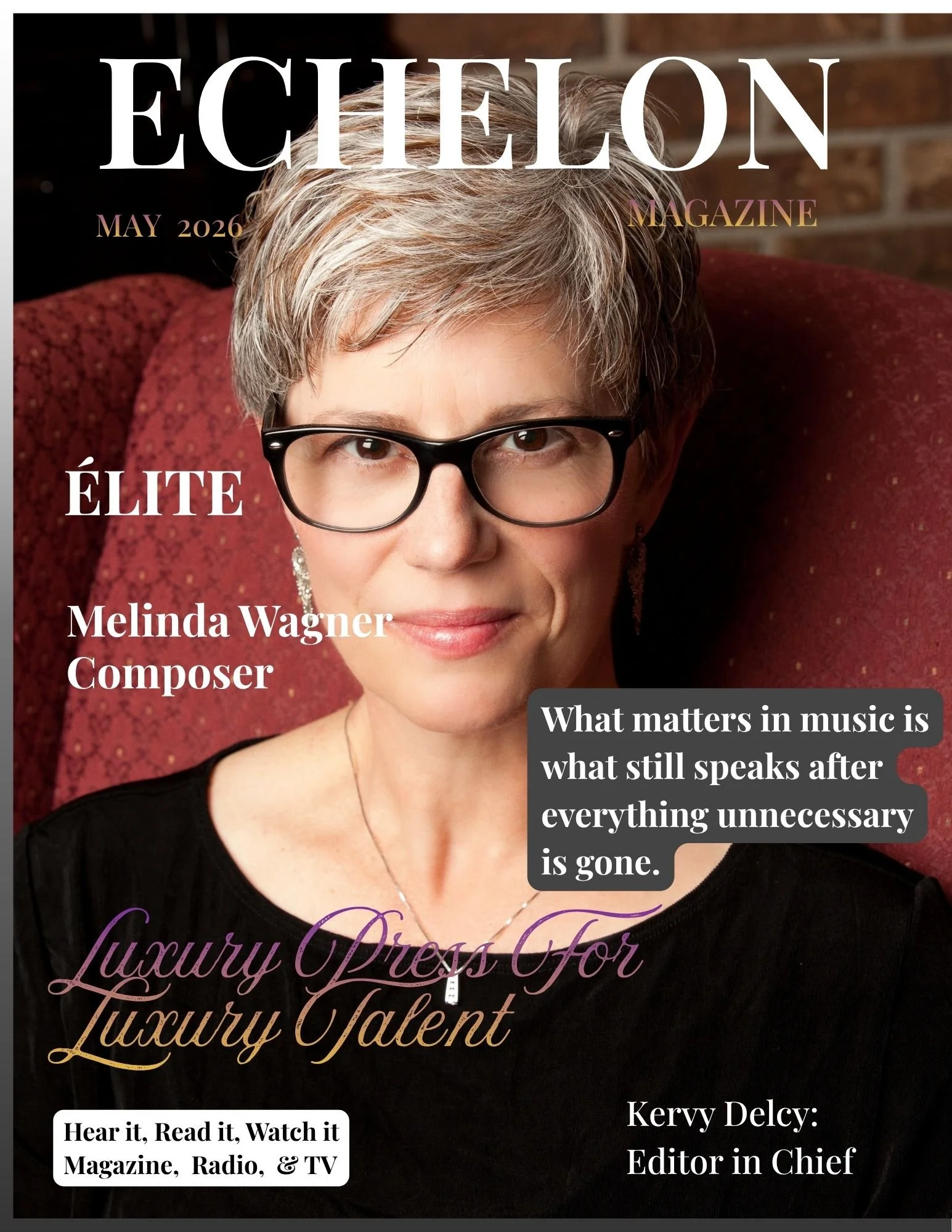
The music speaks when it is allowed to stay clear.
In contemporary discourse, compositional identity is often treated as something constructed through method, influence, and aesthetic positioning. Melinda Wagner’s work complicates this framing. Her reflections point less toward a manufactured identity than toward one that is gradually clarified over time, formed not through assertion, but through sustained attention to what is already present in listening.
From the outset, her relationship to music resists clean categorization. It is neither purely intuitive nor strictly disciplined but emerges instead from a continual negotiation between the two, where instinct is not opposed to craft, and craft does not overwrite instinct, but both are constantly tested against the act of hearing.
This resistance to categorization is not an intellectual stance adopted after the fact. It is embedded in how she describes her earliest experience of music, not as an entry point into a field, but as a form of continuity. She speaks of music not as something she began doing, but as something that has always been there, inseparable from her own sense of self. The language she uses is not metaphorical so much as anatomical: music is not adjacent to her identity; it is part of its structure.
This continuity does not eliminate discipline but reframes it. The recognition that music requires sustained labor came later, and with it, a recalibration of what it means to work within something that already feels inherent. What begins as immediacy becomes practice. What begins as fluency becomes construction.
Yet even within this shift, Wagner’s process resists pre-defined systems. She does not begin with formal architecture or conceptual frameworks. Instead, she begins with tempo, not as a technical marking, but as an initial condition that shapes everything that follows. Tempo, for her, is not a parameter among others; it is a decision that determines the emotional and structural possibilities of a work before any pitch material is fixed.
From there, she turns to the piano, where improvisation remains central. Ideas are not generated as finished statements but as fragments tested through repetition, variation, and refusal. Many paths are abandoned. Some persist. The process is less linear development than sustained listening under changing conditions.
This way of working reflects a broader philosophy in which composition is not primarily the invention of material, but the recognition of what can hold. “I could be okay with music that I actually like,” she observes in another context, a statement that reframes aesthetic decision-making not as justification, but as acceptance. The criterion is not external validation, but internal coherence, which remains convincing when heard again.
Under the weight of style
Wagner’s formative years unfolded within an academic environment shaped by post-serial orthodoxy, in which tonal writing was often regarded as retrograde. In that context, compositional legitimacy was closely tied to adherence to systems derived from Arnold Schoenberg's legacy and his successors’. To write lyrically, or to rely on triadic language, was not simply unfashionable; it was, at times, discouraged.
Her response to this environment was not polemical. She did not reject contemporary techniques, nor did she fully submit to them. Instead, her work gradually established a position that was neither oppositional nor compliant, but self-determined. As the broader musical landscape became more pluralistic, this position became less marginal, but it was never dependent on validation from that shift.
A key feature of her work is its narrative quality, though this term requires careful use. Her music does not narrate in the programmatic sense. Rather, it constructs sequences of sound that imply direction without dictating meaning. Time in her work is shaped through gesture and contour, allowing a sense of unfolding that remains open rather than resolved into an explicit story. This relationship to time becomes especially important in understanding how Wagner conceives musical experience itself. Her work does not unfold as a collection of isolated moments, but as a continuously evolving temporal structure in which meaning depends upon memory and anticipation as much as immediate perception.
This is particularly evident in WillowSpeak, a piece composed between larger works. The piece is modest in scale, but not in intent. It is built from lyrical material that unfolds without urgency, allowing silence, resonance, and repetition to function as structural forces rather than gaps to be filled.
Wagner describes the initial impulse for the piece as a simple melodic idea, “a sad little thing,” whose emotional character was not imposed, but discovered through writing. The title came later, suggesting the image of a willow, not as an illustration but as an analogy: a form responsive to forces outside itself, yet coherent in its own structure.
What is notable here is not only the material itself, but the absence of excess explanation around it. The music is allowed to remain what it is without being overdetermined by external justification. Meaning is not extracted; it may remain implicit.
This attitude extends to her understanding of the audience, though not toward ease or accommodation in a simplistic sense. Wagner does not frame composition as an attempt to flatten complexity or reduce demands on the listener. Instead, she works to make her musical language as clear as possible on its own terms, without abandoning its internal density. Clarity, in this sense, is not simplification; it is legibility within a specific musical logic.
Her distinction between art and entertainment becomes central here. Art, in her view, is not passive; it expects something back. It asks for active rather than receptive engagement. Entertainment, by contrast, can unfold without that reciprocal demand. Her music belongs firmly to the first category. It is not constructed from a sequence of isolated pleasant moments, but from continuities that require sustained attention to become perceptible as a coherent form.
This is where the idea of deep listening enters, not as a metaphor, but as a temporal discipline. Music, for Wagner, exists simultaneously across three dimensions of time: what has already sounded, what is sounding now, and what is anticipated. These dimensions remain inseparable. Every present moment in a piece is shaped by the memory of what preceded it and the expectation of what may follow. To listen deeply, then, is to inhabit all three tenses at once.
Within this framework, the listener is not asked to agree with the music, nor even necessarily to enjoy it. What is asked instead is engagement: the willingness to remain with the work long enough for its internal logic to emerge. If listeners meet the music halfway, even a quarter of the way, the act of composition has succeeded on its own terms. Wagner accepts that not every listener in the hall will enter that space. The possibility of partial reach is not a failure of the work, but part of its condition.
Equally important is her view of collaboration. For Wagner, performers are not secondary to the work but integral to its realization. Each performance introduces variability, not as distortion, but as continuation. The score does not contain the work in full; it initiates a process that remains open in time.
This openness reinforces a central tension in her practice: the balance between control and relinquishment. Composition requires precision of decision, yet performance inevitably introduces forms of unpredictability that cannot be entirely contained. The work ultimately exists between those conditions, authored yet continually reinterpreted by others' bodies and imaginations.
Sustaining the Work
When asked what sustains her, Wagner’s response is not singular. It includes discipline, curiosity, and collaboration, but above all, a commitment to continuation. Rejection is not an anomaly within her account of artistic life, but its structural condition. The appropriate response is not avoidance, but persistence.
This persistence is not framed heroically. It appears instead as part of the ordinary reality of artistic practice: continuing to work despite uncertainty, despite limited reception, despite the impossibility of controlling how a work will be encountered once released into the world.
What emerges across her reflections is not a system, nor an aesthetic doctrine, but a consistent orientation toward sound as something that must be continuously re-earned through attention. Composition, in this sense, is not the assertion of identity through material, but the ongoing verification of that identity through listening.
And perhaps this is where Wagner’s work ultimately resists many of the contemporary pressures on artistic production. The music does not attempt to resolve itself too quickly into concept, ideology, or explanation. It remains willing to inhabit ambiguity without surrendering coherence, to remain lyrical without apology, and to ask for concentration in a cultural moment increasingly resistant to sustained attention.
What ultimately defines the work of Melinda Wagner is not the assertion of a style, but the sustained act of listening from which decisions are made. Conviction, in this sense, is not certainty in advance, but the willingness to remain accountable to what is heard again and again, without prematurely translating it into justification. The work remains open, not unfinished, but alive to the possibility that hearing itself is never fully complete.