Benjamin C.S. Boyle: Precision, Memory, and the Ethics of Sound
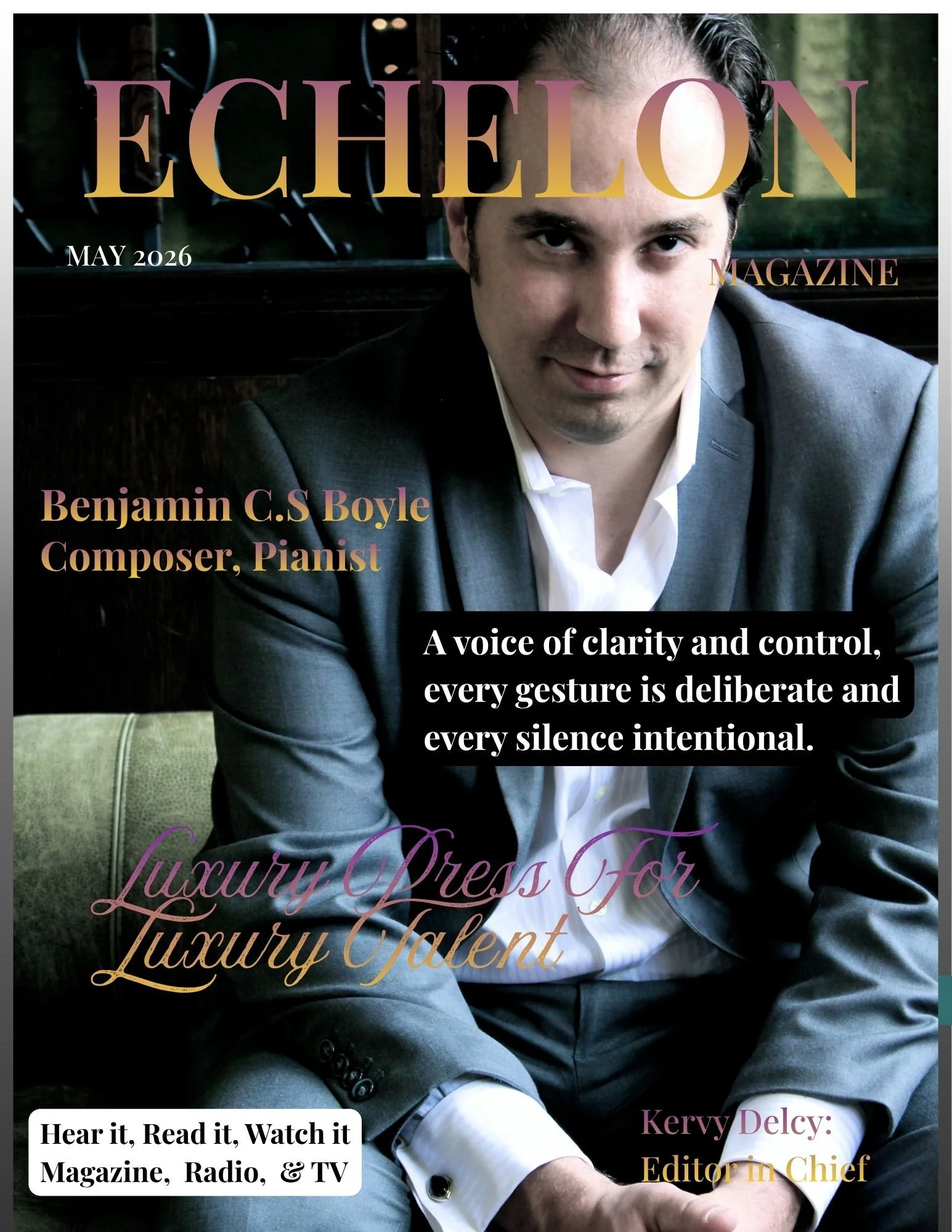
Composition is not output, but responsibility made audible.
For certain composers, music is not an output but a responsibility, something carried with care rather than produced casually.
Benjamin C. S. Boyle belongs to that category. His work exists in a space where clarity is not simplification, and accessibility is not compromised. Instead, both are treated as outcomes of discipline: the result of long internal negotiation between idea, structure, and sound. He describes his musical voice in understated terms: expressive, lyrical, and accessible, but the simplicity of those words conceals a more complex reality. In Boyle’s hands, clarity is never decorative. It is constructed. And behind that construction lies a belief that composition is never solitary. It is a triangular condition: composer, performer, and listener, each one dependent on the other for the work to fully exist.
The Discipline of Not Repeating Oneself
Boyle’s artistic philosophy begins with a refusal: the refusal to become static. He often recalls a phrase from his broader musical training environment, “never sit on the comfy chair.” It is not a doctrine, nor a formal theoretical principle, but something closer to a behavioral warning about artistic life. Comfort, in this sense, is not ease; it is repetition disguised as mastery. For Boyle, repetition is one of the quietest risks in composition. Not because it is inherently wrong, but because it can disguise itself as success. A language that works can easily become a language that stops evolving.
Yet his approach is not iconoclastic. He does not seek rupture for its own sake. Instead, he works within continuity, allowing each piece to extend what came before it without simply repeating it. In this sense, his artistic lineage aligns more closely with Johannes Brahms than with modernist rupture. Brahms expanded musical language not by discarding tradition, but by deepening it, by pushing familiar materials into more complex emotional and structural relationships.
Boyle operates in a similar space: forward motion through refinement, not rejection.
Lineage and Formation
Boyle’s formal training places him firmly within one of the most influential pedagogical traditions in Western classical music.
He studied pedagogy under Philip Lasser, a direct intellectual descendant of Nadia Boulanger, whose influence shaped generations of composers through an emphasis on counterpoint, harmonic awareness, and structural discipline. This lineage is not simply historical for Boyle; it is active. It informs how he thinks about musical material, how he organizes time, and how he evaluates a piece's internal coherence. In this tradition, analysis is not an academic exercise separate from creation. It is part of creation itself. To understand a piece is, in a sense, to begin writing it more clearly.
Before the First Note
One of the most significant shifts in Boyle’s creative process has been temporal.
Where earlier compositional habits often begin at the instrument, his current method begins before sound. The piano, once central as a thinking space, now arrives later in the process. Instead, the initial stage is entirely internal: form, pacing, harmonic direction, and textural intention are established before physical experimentation begins. What exists at this stage is not improvisation, but conceptual certainty. By the time sound is tested, the piece is already partially formed in his mind. The instrument becomes a means of confirmation rather than discovery.
This reversal reflects a broader compositional philosophy: sound is not the generator of ideas, but their realization.
Craft as a Form of Clarity
Boyle speaks about craft with unusual directness in a contemporary context where such language is often avoided. “I can hear immediately,” he says, “when a composer understands harmony.” The statement is not meant as a provocation but as an observation. For him, craft is not an aesthetic preference; it is structural literacy. It determines whether musical ideas can sustain themselves over time.
Without that foundation, expression becomes unstable. With it, even simple material can carry structural weight. In Boyle’s thinking, technical understanding is not separate from emotional impact. It is what makes emotional impact coherent.
If there is a single concept that continues to expand in Boyle’s work, it is harmony.
Not harmony as a fixed system of rules, but harmony as an evolving field of relationships.
Over time, He acknowledges that his harmonic language has become more complex. This is not a stylistic goal, but a natural consequence of continued inquiry. Each piece becomes a space to test how harmonic tension behaves under different structural conditions.
There is a subtle humor in how he describes this evolution, but the underlying idea is serious: harmony is not something to be solved. It is something to be explored continuously. Even after decades of composition, it remains open-ended.
Writing for the Voice
Although trained as a pianist, Boyle’s most extensive body of work lies in vocal music. His output includes over a hundred songs and multiple song cycles, revealing a sustained engagement with text, breath, and the human voice as a vehicle of expression. Unlike instrumental abstraction, vocal music introduces an immediate relationship with language, shaping how musical time interacts with meaning.
This focus extends into larger forms, particularly cantatas, where individual voices are integrated into broader structural frameworks. His Cantata No. 2: Voyages, recorded by The Crossing Choir, received a GRAMMY nomination. The work reflects a balance between large-scale structure and detailed vocal writing, demonstrating Boyle’s ability to maintain clarity across extended forms.
The Reality of the Contemporary Composer
Boyle is candid about the conditions of composing in the present moment.
There is, he notes, more access than ever before. Music can be shared instantly, globally, without institutional mediation. But this accessibility has also produced saturation. Visibility is no longer guaranteed by quality alone. In this environment, the role of the composer has expanded far beyond writing. Administration, communication, networking, and self-presentation have become essential components of professional survival. “You have to be everything,” he observes.
The consequence is fragmentation: time that once belonged entirely to composition is now distributed across multiple roles. Earlier generations of composers, by contrast, operated within systems that allowed more sustained focus on writing itself. The comparison is not nostalgic, it is structural.
Against Pretension in Listening
Despite his technical rigor, Boyle’s artistic intent is not exclusionary. He does not write to obscure meaning, nor to create barriers to entry. Instead, he consistently returns to the idea of direct experience. Music, in his view, does not need to be decoded to be valid. It can exist across multiple levels of engagement, immediate listening, or deeper structural awareness, without requiring one to invalidate the other.
“I want people to enjoy it,” he says, “on multiple levels.”
This idea challenges a persistent assumption in contemporary classical discourse: that difficulty is equivalent to depth. Boyle rejects that equivalence. For him, seriousness is not measured by opacity, but by integrity.
Interpretation and Performer Agency
Boyle places significant value on the performers' role in shaping the identity of his work. When performers bring their own interpretive decisions, sometimes in ways he did not anticipate, he does not view this as deviation but as extension. A score, once released, becomes a shared space of interpretation rather than a fixed object.
He is particularly attentive to moments where interpretation diverges from expectation. Not all differences are corrections; some are revelations. In these moments, the work becomes something larger than its initial conception.
Rehearsal as Revelation
Boyle also acknowledges a tension between compositional intention and performed reality. Like many composers working with digital tools, he recognizes the limitations of playback technology in representing orchestral or ensemble writing. Computer realizations can approximate sound, but they cannot replicate the complexity of acoustic interaction. As a result, rehearsal becomes a space of discovery, not only for performers, but for the composer as well. Even with careful preparation, sound behaves differently in a live space. That unpredictability is not a flaw, but a condition of the medium itself.
Living Within the Work
To be a living composer, Boyle suggests, is to exist in constant negotiation between creation and reception. There is visibility, but also competition. There is access, but also dilution. There is opportunity, but also pressure to constantly produce, communicate, and maintain presence. In this environment, sustaining depth becomes an act of discipline. And yet, Boyle remains committed to long-form thinking to large-scale works, to vocal cycles, to symphonic ambitions that unfold over time rather than immediacy.
These are not gestures toward permanence. They are gestures toward continuation.
There are composers who write to be remembered.
There are others who write to be understood.
And then there are those, rarer still, who write as if music is not a product of time, but a way of inhabiting it more honestly.
In the work of Benjamin C. S. Boyle, sound is never allowed to become decoration. It is kept awake. It is questioned, refined, and returned to itself again until it holds only what it truly needs.
Nothing in excess. Nothing accidental. Nothing that does not earn its place.
And in that refusal to settle, whether into style, habit, or expectation, his music leaves behind something quieter than certainty, but more enduring:
a reminder that clarity is not the absence of complexity, but the decision to make complexity legible to the ear.