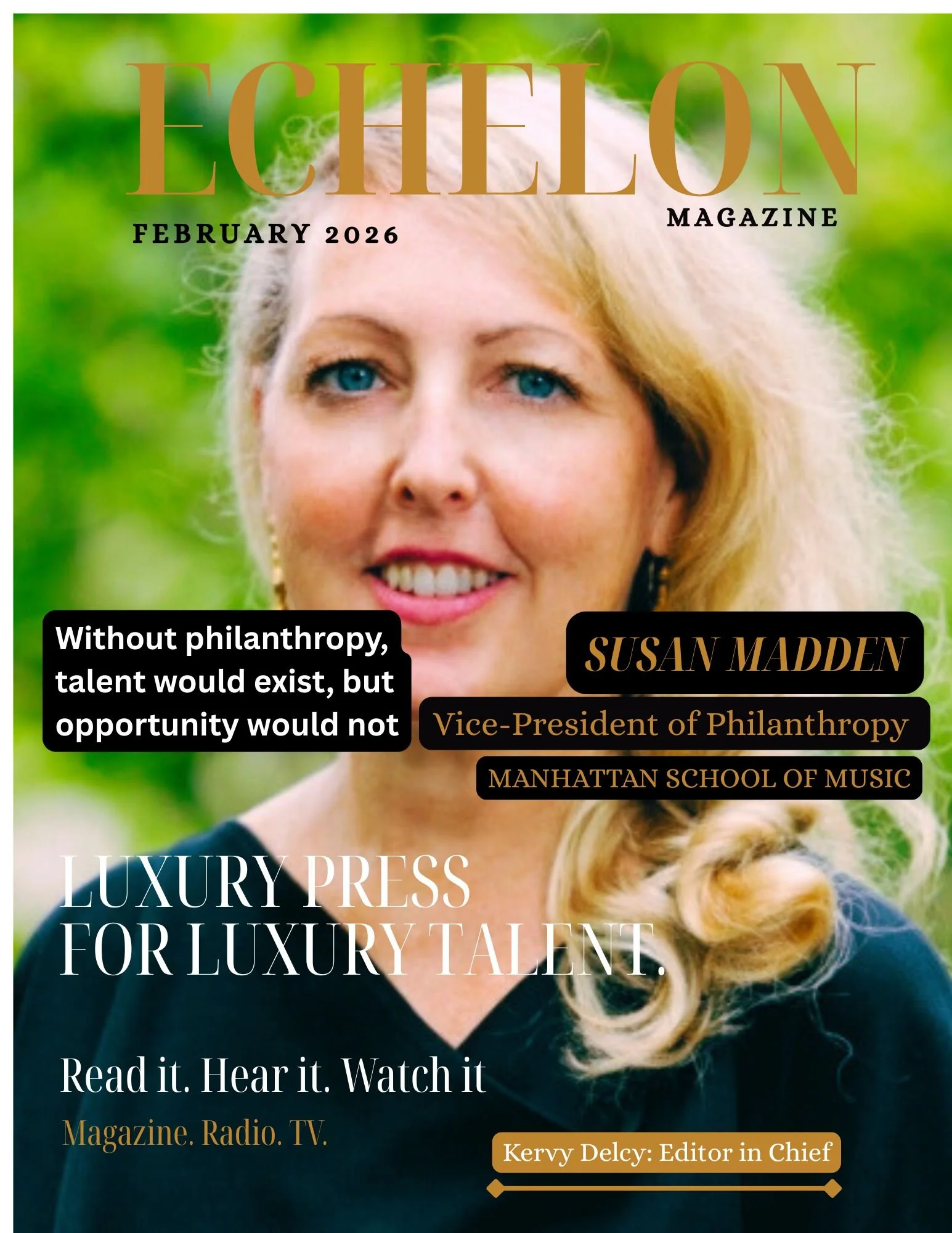
History remembers the artist. Susan Madden- Vice-President of Philanthropy at Manhattan School of Music.
“We always remember the artists,” Susan Madden once observed. “What do we remember in Bach’s time? We remember Bach.”
Her remark is not an erasure of patronage, nor a dismissal of institutional leadership. It is an acknowledgment of cultural memory. We archive composers, virtuosi, conductors, and voices that endure. We canonize the visible. What we rarely memorialize is the infrastructure that made that visibility possible.
Philanthropy is the unseen structure that makes art possible.
In the United States, especially, the arts do not exist within a fully state-subsidized ecosystem. Unlike many European conservatory systems, American music institutions rely on a hybrid structure: tuition, endowment performance, institutional revenue, and contributed income. Remove philanthropy from that equation, and the system does not merely strain; it contracts. Scholarships shrink. Faculty recruitment becomes difficult. Guest artist residencies decline. Capital improvements stall. Access narrows.
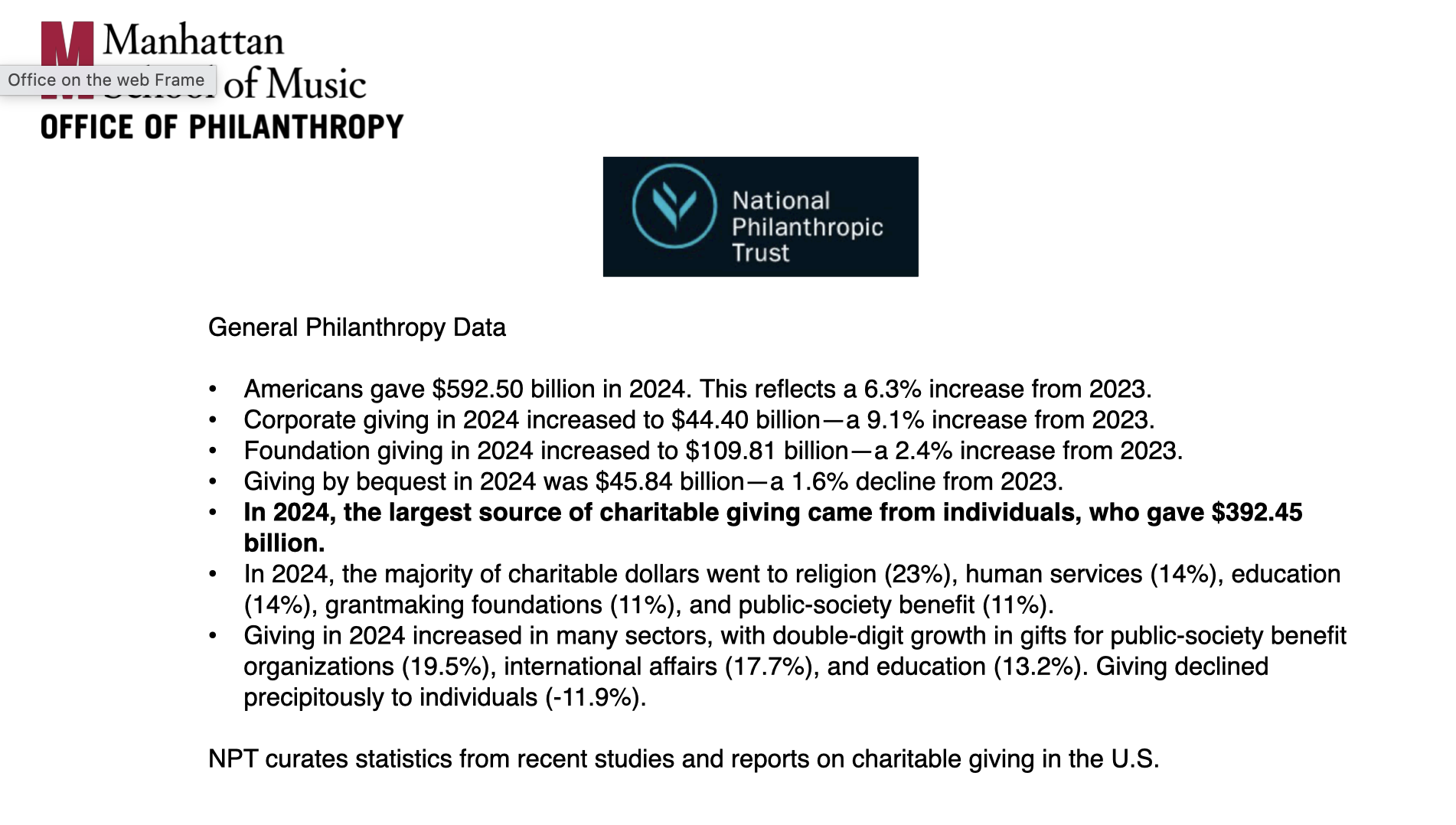
General Philanthropy
At Manhattan School of Music (MSM), one of the country’s leading conservatories, philanthropy is not auxiliary to the mission. It is foundational to it.
Since FY18, Susan Madden has served as MSM’s Vice President for Philanthropy, overseeing a period of measurable and strategic expansion. Under her leadership, the institution has seen an 80% increase in giving to its annual fund, including a tripling of foundation giving. New donor affinity groups have been established. High-profile stewardship events have expanded in both scale and sophistication. She has worked alongside the President and Board of Trustees to secure more than $20 million for the School’s endowment and $7 million in planned gifts, commitments that will shape MSM’s financial stability for decades. The six highest-netting annual galas in the institution’s history have occurred during her tenure.
These are significant achievements in any nonprofit landscape. In the arts sector, where donor fatigue, shifting philanthropic priorities, and economic volatility are persistent realities, they are particularly noteworthy.
Yet metrics alone cannot explain the trust required to achieve them.
Madden’s professional trajectory reveals a consistent alignment with cultural institutions where public engagement and institutional sustainability intersect. She spent twelve years at the Solomon R. Guggenheim Museum as Director of Membership and Individual Giving, navigating one of the world’s most internationally visible arts organizations. There, she honed the delicate balance between cultivating broad-based membership participation and stewarding major individual gifts.
Her work at the New York Restoration Project, the nonprofit founded by Bette Midler, positioned philanthropy within a different cultural framework: urban renewal, environmental justice, and community access to green space. At the Museum of the City of New York and The Paley Center for Media, she operated at the crossroads of history, media, and public narrative.
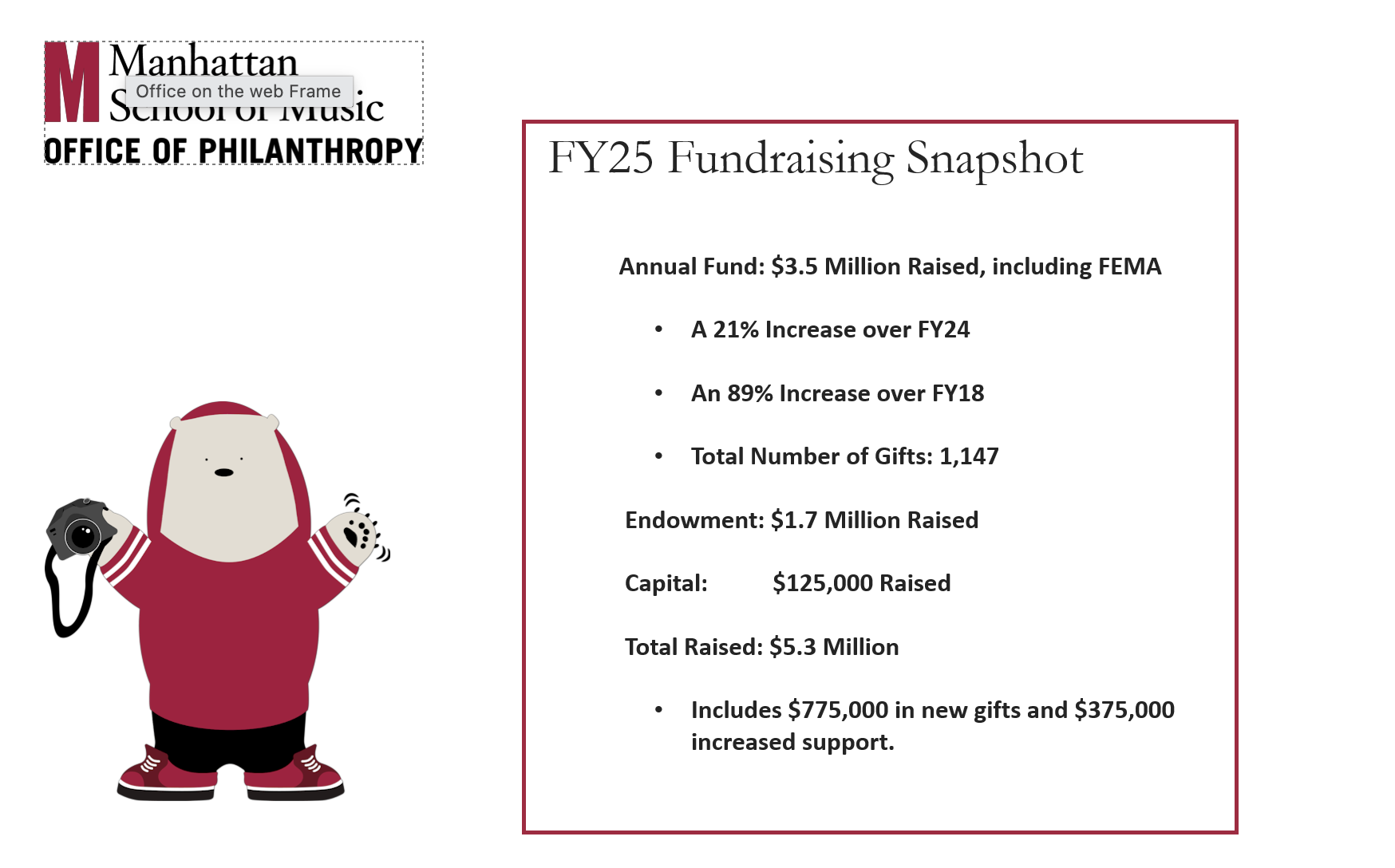
MSM 2025 Fundraising Snapshot
Across these institutions, a throughline emerges, philanthropy as relationship-building rather than revenue extraction.
Those who observe Madden’s approach describe it in terms of integrity, clarity, and consistency. She does not approach donors as financial instruments. She approaches them as partners in institutional continuity. The cultivation of support is not limited to gala evenings or formal appeals. It extends into curated experiences, private tours of Harlem that contextualize MSM’s physical and cultural location, conversations with students whose artistic aspirations embody the institution’s mission, and carefully structured communications that articulate not simply need, but vision.
This philosophy of engagement has material consequences.
A donor recently entrusted MSM with a long-term asset that will benefit the school for decades. Such gestures do not emerge from momentary enthusiasm. They arise from sustained trust, from the confidence that leadership will steward resources with transparency and purpose.
The importance of this trust cannot be overstated.
Philanthropy in arts education directly determines who has access to training. Conservatories are intensive environments. Tuition alone rarely covers the true cost of instruction, faculty salaries, performance production, facility maintenance, and global engagement initiatives. Scholarships bridge that gap. Without them, admission becomes increasingly correlated with financial capacity rather than artistic merit.
A 80% increase in the annual fund is therefore not merely an institutional success. It represents expanded scholarship pools. It represents the ability to admit and retain students who might otherwise be excluded. It represents creative risk-taking, the freedom to program contemporary repertoire, commission new works, and support interdisciplinary exploration.
In short, it safeguards artistic diversity.
In a moment when public arts funding in the United States remains vulnerable to political fluctuation and economic cycles, philanthropic leadership becomes even more critical. Cultural institutions must articulate their relevance, their societal contribution, and their stewardship capacity with clarity. They must persuade donors not only of artistic excellence, but of institutional resilience.
Madden’s tenure at MSM reflects an understanding of this landscape. Her development of new donor groups expands generational participation. Her creation of refined development materials, including comprehensive reports, strengthens transparency and accountability. Her stewardship of high-performing galas demonstrates not simply event planning acumen, but the capacity to align fundraising outcomes with mission-driven storytelling.
The arts endure in memory because institutions endure in structure.
When we recall Bach, we rarely discuss the ecclesiastical systems and patronage networks that sustained him. Yet without those systems, the music would not have been written, copied, preserved, and performed. Similarly, when future generations look back on the artists emerging from MSM today, the composers, instrumentalists, conductors, and educators shaping global stages, their visibility will obscure the architecture that made their formation possible.
That continuity is made possible through philanthropy.
It is not glamorous work. It unfolds in meetings, proposals, stewardship reports, strategic plans, and conversations that extend beyond performance halls. It requires emotional intelligence as much as fiscal acumen. It requires patience. It requires credibility.
Most of all, it requires belief.
Susan Madden’s leadership at Manhattan School of Music has demonstrated how belief, carefully cultivated and responsibly managed, can translate into institutional strength. The measurable growth in contributed income is not only a fundraising achievement. It is a statement of confidence from a community of donors who trust the school’s direction and its stewardship.
We remember the artists.
But artists are cultivated within ecosystems sustained by people who understand that art is not a luxury. It is a cultural necessity.
Philanthropy ensures that necessity remains viable.